
How Knowledge Managers Become Powerful

Knowledge managers know how to use KM tools, how to ask others for help, who should be connected to whom, who would benefit from a piece of information, and how to persuade others to use information effectively. Those who play these roles, and especially those who combine several of them, can function as “power knowledge workers”, facilitating knowledge flow throughout the organization.
What to look for in KM team members
In addition to the above skills and roles, knowledge managers must subscribe to many information sources, belong to many communities, and read many publications—always looking out for what may be useful to others in the organization.
All good managers should do these things, but they may not know how to best do so. Therefore, Knowledge Managers participating in a KM program can support functional managers in all of these activities. Good knowledge managers regularly inform their management colleagues about an article, book, presentation, or conference call relevant to their areas of responsibility. These colleagues can subscribe to the same sources and join the same communities; even if they don’t, they will appreciate being selectively alerted when content applies to them.
All knowledge workers in the organization should view sharing, innovation, reuse, collaboration, and learning as part of their jobs. But as Malcolm Gladwell wrote, not everyone is a connector, maven, or salesman. So, those who play these roles, and especially those who combine several of them, can function as “power knowledge workers”, facilitating knowledge flow throughout the organization.
Good knowledge managers have worked in many different roles, so they have experienced employee needs first-hand. They know about the organization, including who does what, where to find information, and the ways to get things done. Within the organization, they are active in communities, subscribe to newsletters, attend seminars and conference calls, and visit websites. Outside, they attend seminars and conferences, read books, subscribe to periodicals, visit blogs and websites, and participate in online communities.
Knowledge managers look for unmet knowledge-related needs, and try to develop ways to meet them using people, process, or technology. They like to help others who are looking for information, trying to figure out how to use tools, or seeking to connect with others. They introduce people to one another, invite them to join communities, and pass along items of interest.
Knowledge managers fill the roles of KM leaders, project leaders, and knowledge assistants. Here is the profile of a good knowledge manager.
Profile of an effective Knowledge Manager
Experience
- Management: supervised people, led work teams, managed a business or functional unit
- Project management: successfully managed projects to meet deadlines, provide deliverables, and adhere to budgets
- Communications: published documents, gave presentations, and managed communications programs
- 50 KM Components: for many of these, performed evaluations, led implementation projects, and used them regularly
- Reputation: has earned the respect of people both inside and outside the organization based on accomplishments, networking, and communications
Skills
- Leadership: able to influence others, lead work teams, and manage projects
- Communications: excellent at writing, speaking, presenting, and using a variety of communications vehicles
- Process and Technology: able to quickly learn and master a wide variety of tools and processes
- 50 KM Components: expert at using many of these
- Analysis: able to seek input, analyze information, consider alternatives, and make good decisions
KM leaders need to perform the following tasks:
- Improve business results by institutionalizing a knowledge sharing culture. With the help of the senior executive and the other leaders in the organization, take steps to achieve a positive culture that rewards caring, sharing, and daring.
- Define, maintain, and execute the KM implementation plan for the organization. This is the overall program plan for the KM initiative.
- Define, communicate, and implement people, process, and technology components for sharing, innovating, reusing, collaborating, and learning. These are the core elements that enable the KM program.
- Define KM measurements and rewards for the organization and KM goals for all relevant members. This aligns individual and organizational objectives.
- Report regularly on the organization’s performance against KM metrics. This lets the leadership team know how the program is progressing.
- Implement action plans for people, process, and technology projects. These are the detailed implementation plans for each project leader.
- Lead the organization’s KM teams. These include the program staff, the core team, and the KM community.
- Manage the organization’s KM communications. This keeps all users informed on the program.
- Actively participate in communities. Model desired behaviors by being visible as a leader and a member of multiple internal and external communities.
- Network with other KM Leaders. Demonstrate the use of social networks to stay current in the field of knowledge management.
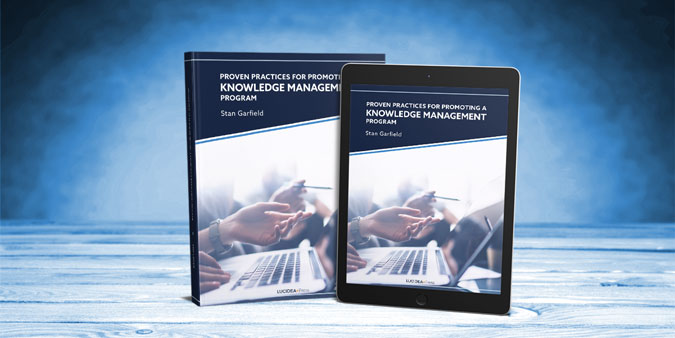
If you’d like to read more on this topic, please consult Stan’s book, published by Lucidea Press, Proven Practices for Promoting a Knowledge Management Program, which offers a broad range of advice and insights drawn from his career as a KM practitioner. If you haven’t, get your free digital copy now!
Similar Posts

The KM Mentor, Part 9: Knowledge Management Certification
KM expert analysis and recommendations for knowledge management training and professional development that help build skills in a variety of specialties under the KM rubric.

Culture on Tap: The Power of Commercial-Cultural Partnerships
When cultural heritage aligns intentionally with local business goals, it unlocks a powerful value exchange that transforms heritage into an economic engine, aligning historical narratives with local commerce.

Month 2 as a New Special Librarian: Assessing and Prioritizing
Any new job can be overwhelming as you begin establishing productive professional relationships. Tips from a library expert on how to move from listening and learning to assessing and prioritizing.

The KM Mentor, Part 8: Top Knowledge Management Trends 2026
The intersection of AI and KM allows knowledge managers to inject the best KM into high-priority organizational AI initiatives; Stan Garfield’s review of 8 Top KM Trends 2026.
Leave a Comment
Comments are reviewed and must adhere to our comments policy.
0 Comments