
Lucidea’s Lens: Knowledge Management Thought Leaders Part 4 – Nancy Dixon

Stan Garfield
 |
Nancy Dixon is a university professor turned consultant. Her work is focused on increasing collaboration and knowledge sharing in the workplace. It involves cultural transformation, using dialogue as the agent of change. |
She has found that the capability to get on top of the unexpected more quickly does not lie inside the head of any one person. Instead, the mind is located between people, in the quality of their relating.
Nancy’s interests include hybrid teams (the best of virtual and face-to-face teams), knowledge management, and conversation. Her books include Common Knowledge: How Companies Thrive by Sharing What They Know, CompanyCommand: Unleashing the Power of the Army Profession (with Burgess, Allen, Kilner and Schweitzer), The Organizational Learning Cycle: How We Can Learn Collectively, and Perspectives on Dialogue: Making Talk Developmental for Individuals and Organizations.
Nancy and I have spent time together at many KMWorld, APQC, Midwest KM Symposium, SIKM Leaders Community, and Columbia University events. She is an active participant in SIKM Leaders Community discussions.
Profiles
Posts
SIKM Leaders Community
- Posts
- October 2007 Presentation – Knowledge Harvest Facilitation with Kate Pugh
- December 2013 Presentation – 3 Eras of KM: Where Has it Been and Where is it Going?
- April 2018 Presentation – The Art of Creating a Trusted Space
Books
- Amazon Author Page
- Company Command: Unleashing the Power of the Army Profession
- Knowledge Management Matters: Words of Wisdom from Leading Practitioners
- Common Knowledge: How Companies Thrive by Sharing What They Know
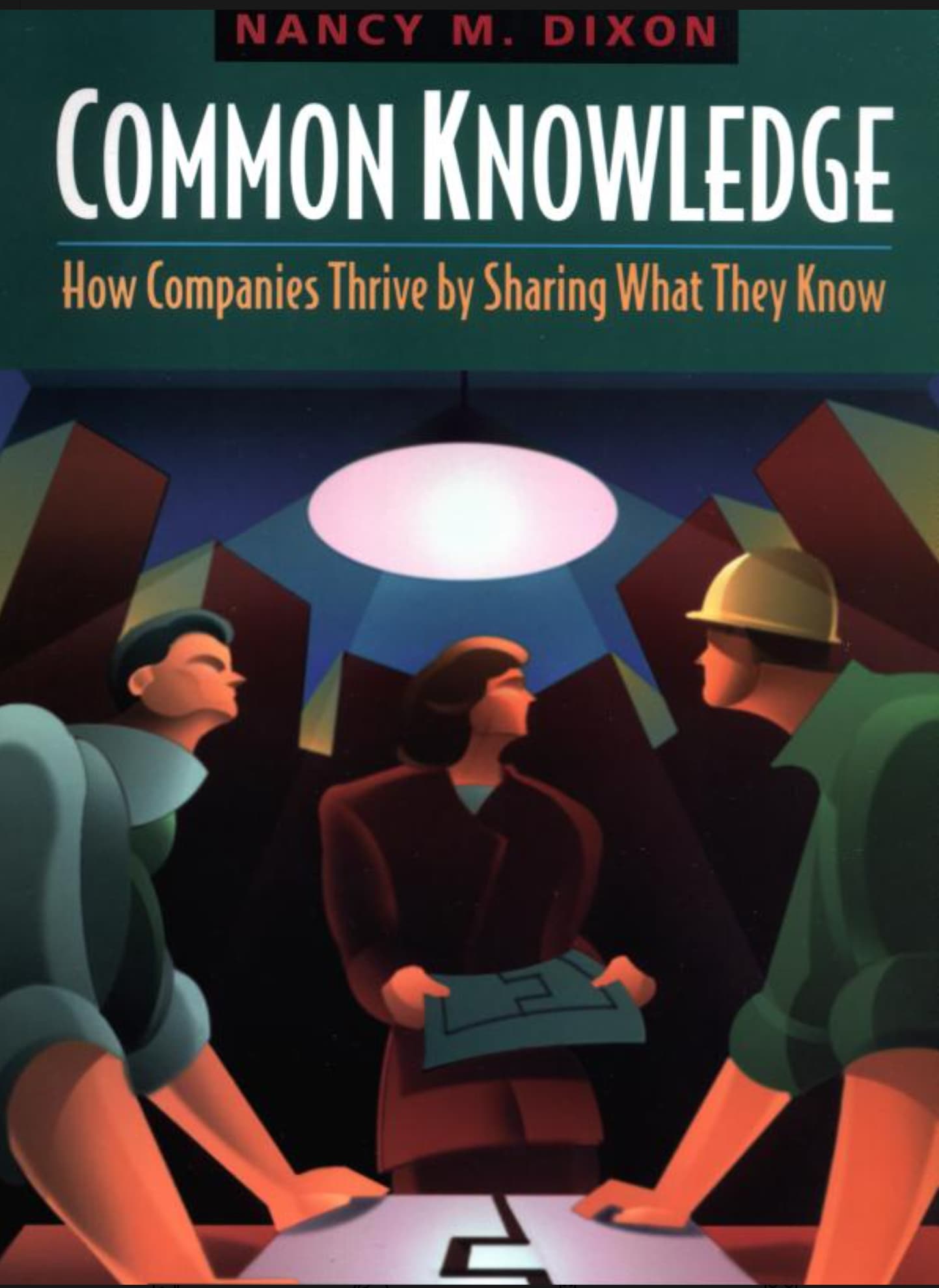
Table of Contents
- Introduction
- Common Knowledge
- Serial Transfer
- Near Transfer
- Far Transfer
- Strategic Transfer
- Expert Transfer
- Changing How We Think about Knowledge
- Building an Integrated System for Knowledge Transfer
Other Content
Does Your Organization Have an Asking Problem?
Knowledge sharing begins with a request, not with a solution. No matter how much knowledge is presented at conferences, held in databases, or emailed to colleagues, knowledge won’t be reused unless a team has a need, something they are struggling with.
Managers sometimes tell me that people in their organization have a problem with sharing knowledge; but more often than not, people aren’t “asking.” The organization has an asking problem, not a sharing problem. When people ask, the sharing problem becomes moot.
How organizations talk about “asking” is critical. When company officials say to professionals, “Don’t be afraid to ask for help,” their words actually work against asking. Asking for “help” denotes helplessness. No competent professional wants that image attached to his or her performance. What professionals do need is to be able to tap into organizational knowledge that is growing and changing — to tap into what others are learning from their ongoing experience. I have labeled this step “scanning,” which connotes an active seeking for something of value.
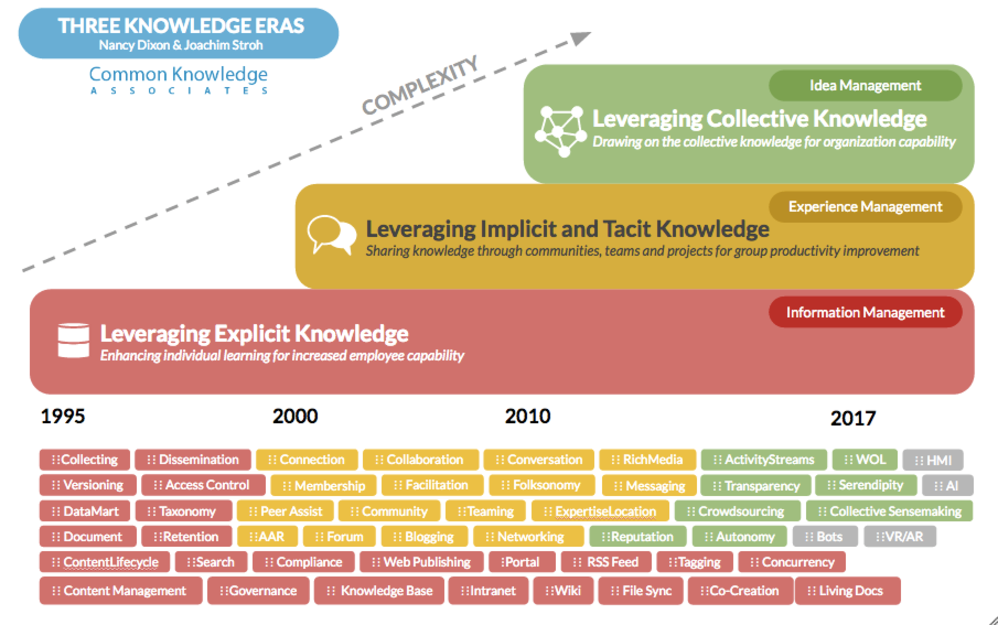
The Three Eras of Knowledge Management
Stan Garfield
Please enjoy Stan’s additional blog posts offering advice and insights drawn from many years as a KM practitioner. You may also want to download a copy of his book, Proven Practices for Implementing a Knowledge Management Program, from Lucidea Press. And learn about Lucidea’s Presto and SydneyEnterprise with KM capabilities to support successful knowledge curation and sharing.
Never miss another post. Subscribe today!
Similar Posts

The KM Mentor, Part 10: The Most Meaningful Knowledge Management Metrics
KM expert Stan Garfield offers details of four sets of meaningful metrics for assessing the impact and successful execution of knowledge management programs.

The KM Mentor, Part 9: Knowledge Management Certification
KM expert analysis and recommendations for knowledge management training and professional development that help build skills in a variety of specialties under the KM rubric.

The KM Mentor, Part 8: Top Knowledge Management Trends 2026
The intersection of AI and KM allows knowledge managers to inject the best KM into high-priority organizational AI initiatives; Stan Garfield’s review of 8 Top KM Trends 2026.

The KM Mentor, Part 7: What Can a Knowledge Manager Accomplish Without a Budget?
No budget for KM? Stan Garfield shows how 20 KM components and the Five Cs let you demonstrate value using only time and effort, and build the case for investment.
Leave a Comment
Comments are reviewed and must adhere to our comments policy.
0 Comments