
Lucidea’s Lens: Knowledge Management Thought Leaders Part 78 – Carl Frappaolo

Stan Garfield

The late Carl Frappaolo founded three companies including Delphi Group and Information Architected. As a consultant, he developed knowledge management strategies for many organizations around the world in both the public and private sector.
Carl’s last role was as Director of Knowledge Management at FSG Social Impact Consultants in Boston.
Carl was the creator of Delphi’s Knowledge Management Methodology (KM2), Portal Design and Development Methodology (PDDM), e-learning methodology (ELM), and Stair-Step design methodology. He sat on the board of the Electronic Document Systems Foundation. He was recognized by AIIM International (the Association for Information and Image Management) as a Master of Information Technology and as an Information Systems Laureate, and in 2000, was bestowed the Distinguished Service Award by AIIM.
Books
Take Knowledge Management with a Grain of Salt
The purpose of knowledge management (KM) is to get people collaborating — to share and reuse know how and experience. Note that this does not place any demand on technology. Indeed, I often stress the best form of KM is talking to everyone who might know something about your focus du jour. The problem with this approach is, of course, scale and recall, and that is where technology provides value. The introduction of KM technologies can provide unlimited knowledge capture and asynchronous discovery. But technology is a double-edged sword, and this is where remembering to approach technology-empowered KM with a grain of salt is important.
Imagine the ability to execute searches on any topic, any issue, and on people’s backgrounds with near perfect total recall. Powerful — right? So where is the other edge of the sword? KM is a balancing act. Unrestricted abilities to capture and retrieve are very powerful. and addicting. Know when enough is enough. Asynchronous communication is a time saver, it’s scalable and powerful — but not to the exclusion of mentoring, discussing, and face-to-face group collaboration, and it should never go so far as to keep you from reaching a decision and taking action.
Collaborate Well or Fail
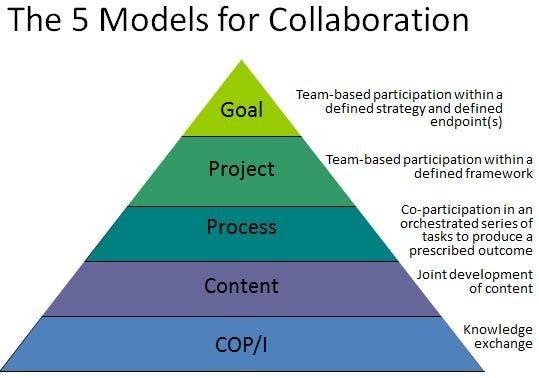
There are three basic types of collaboration (interpersonal, content, and procedural), and 5 basic models or goals. The latter are depicted in the graphic below. They are shown in a pyramid for two reasons: the models closer to the base of the pyramid are more common (therefore broader in the illustration), and the models are inclusive; as you move up the pyramid the models often (not always) inherit the characteristics and needs of the models below them.
The point is that collaboration benefits from a deliberate model and strategy, that begins with assessing which of the basic models your effort requires. While it may be nice to think that collaboration is all about viral and organic growth, research and experience indicate that there is ample room for some control and management of the processes, as well as the knowledge and content captured in the process.
Knowledge Management 2.0
Searching for KM software that enables you to curate, manage, and share organizational intelligence in a single venue? Get in touch to learn about Presto!
Stan Garfield
Please enjoy Stan’s blog posts offering advice and insights drawn from many years as a KM practitioner. You may also want to download a free copy of his book, Lucidea’s Lens: Special Librarians & Information Specialists; The Five Cs of KM from Lucidea Press, and its precursor, Proven Practices for Promoting a Knowledge Management Program. Learn about Lucidea’s Presto, SydneyDigital, and GeniePlus software with unrivaled KM capabilities that enable successful knowledge curation and sharing.
**Disclaimer: Any in-line promotional text does not imply Lucidea product endorsement by the author of this post.
Never miss another post. Subscribe today!
Similar Posts

The KM Mentor, Part 7: What Can a Knowledge Manager Accomplish Without a Budget?
No budget for KM? Stan Garfield shows how 20 KM components and the Five Cs let you demonstrate value using only time and effort, and build the case for investment.

The KM Mentor, Part 6: The 10 Biggest Mistakes New Knowledge Managers Make
KM expert Stan Garfield offers his analysis of the 10 strategic mistakes it’s easy to make as a new knowledge manager, with practical options to proactively prevent them.

The KM Mentor, Part 5: The First 90 Days
Responding to the question “What should I do in my first 90 days as a knowledge manager?” expert Stan Garfield lists practical suggestions that can set you up for success.

The KM Mentor, Part 4: Five Key Knowledge Management Practices
In Part 4 of the KM Mentor series, Stan Garfield answers: “What are five practices every KM program should adopt?” His recommendations span community, user experience, GenAI search, and more.
Leave a Comment
Comments are reviewed and must adhere to our comments policy.
0 Comments