
KM Component 47 – Gamification Applications and Digital Badges

Stan Garfield
Gamification applications are tools that use game mechanics to motivate desired knowledge management behaviors.
These applications typically use mechanisms for awarding and tracking points for creating, sharing and reusing knowledge.
Digital badges are validated indicators of accomplishment, skill, quality, or interest that can be earned. Badges are a visual, short-term reward for completing an action, given to users for performing a certain number of actions of a given type
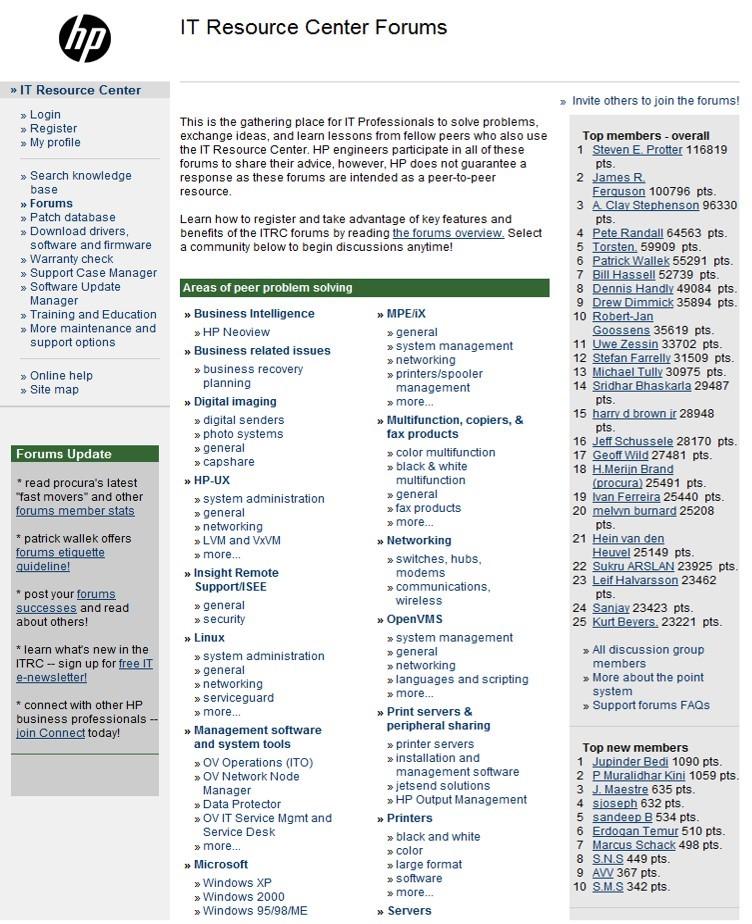
You can use a points system with or without rewards. An example of one without rewards was HP’s IT Resource Center (ITRC) Forums which offered a points tracking system to recognize those who shared their knowledge. Here was the description: “This is the gathering place for IT Professionals to solve problems, exchange ideas, and learn lessons from fellow peers who also use the IT Resource Center. HP engineers participate in all of these forums to share their advice, however, HP does not guarantee a response as these forums are intended as a peer-to-peer resource.”
The “Submit Points” option allowed members to rate replies to their questions by assigning points to those members who provided replies or solutions to problems. On the website, the Top 25 members and the Top 10 new members were listed prominently, and this helped encourage members to help each other and award points as a result.
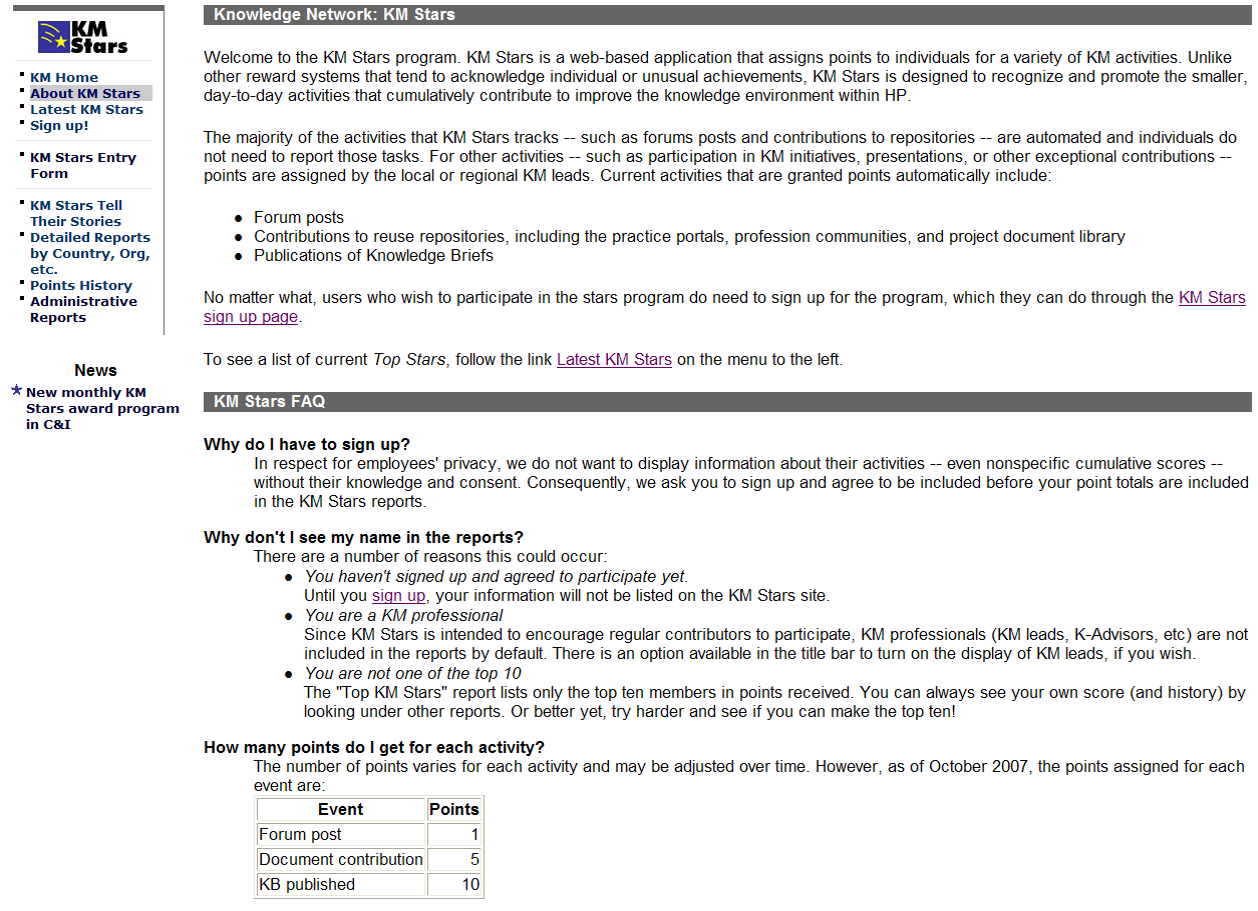
Another example was the KM Stars program which was used at HP to track points and create rankings. Other companies, including Accenture, Cisco, and IBM, have implemented similar programs.
Commercial tools currently available include:
You can also develop your own web-based application to keep track of KM points. These points can be earned by contributing reusable content to an approved knowledge repository that is later reused by others, reusing content from an approved knowledge repository and submitting user feedback for that content, or assisting in a KM initiative approved by a member of the KM team. KM initiative activities can include regularly answering questions in a threaded discussion, serving as an ask the expert contact, actively moderating a threaded discussion, presenting on a community call or at a community event, participating in a pilot, or anything else that helps the KM program to succeed.
In order to receive points for contribution, all required metadata must be completed as part of the submission. In order to receive points for reuse, users must click on “I reused this content” or “I found this content useful.” Doing so triggers points being credited to both the re-user and the original contributor.
These ideas give you a starting point for designing your own system. You can choose to include any or all of these concepts or think of others which are more suitable for your organization. The key is to try something simple to see if it works. You can try giving financial rewards to those who earn the most points or recognize them in some other way. Publishing the leaders on the KM home page, in newsletters, and in special messages from the senior executive will help reinforce the importance of the program, spur a friendly competition between users, and recognize those who excel.
One lesson learned was to ensure that the incentive points tracking system automatically detects all desired actions and doesn’t require manual entry. When HP first launched its KM Stars program, points for reuse needed to be requested by submitting a form. It quickly became apparent that people were unlikely to do this, so manual entry of points requests was eliminated, the system was simplified in the process, and it became more effective as a result.
- Webinar Recordings
- Blog Posts
Stan Garfield
Please enjoy Stan’s additional blog posts offering advice and insights drawn from many years as a KM practitioner. You may also want to download a copy of his book, Proven Practices for Implementing a Knowledge Management Program, from Lucidea Press. And learn about Lucidea’s Presto and SydneyEnterprise with KM capabilities to support successful knowledge curation and sharing.
Never miss another post. Subscribe today!
Similar Posts

The KM Mentor, Part 7: What Can a Knowledge Manager Accomplish Without a Budget?
No budget for KM? Stan Garfield shows how 20 KM components and the Five Cs let you demonstrate value using only time and effort, and build the case for investment.

The KM Mentor, Part 6: The 10 Biggest Mistakes New Knowledge Managers Make
KM expert Stan Garfield offers his analysis of the 10 strategic mistakes it’s easy to make as a new knowledge manager, with practical options to proactively prevent them.

The KM Mentor, Part 5: The First 90 Days
Responding to the question “What should I do in my first 90 days as a knowledge manager?” expert Stan Garfield lists practical suggestions that can set you up for success.

The KM Mentor, Part 4: Five Key Knowledge Management Practices
In Part 4 of the KM Mentor series, Stan Garfield answers: “What are five practices every KM program should adopt?” His recommendations span community, user experience, GenAI search, and more.
Leave a Comment
Comments are reviewed and must adhere to our comments policy.
0 Comments