

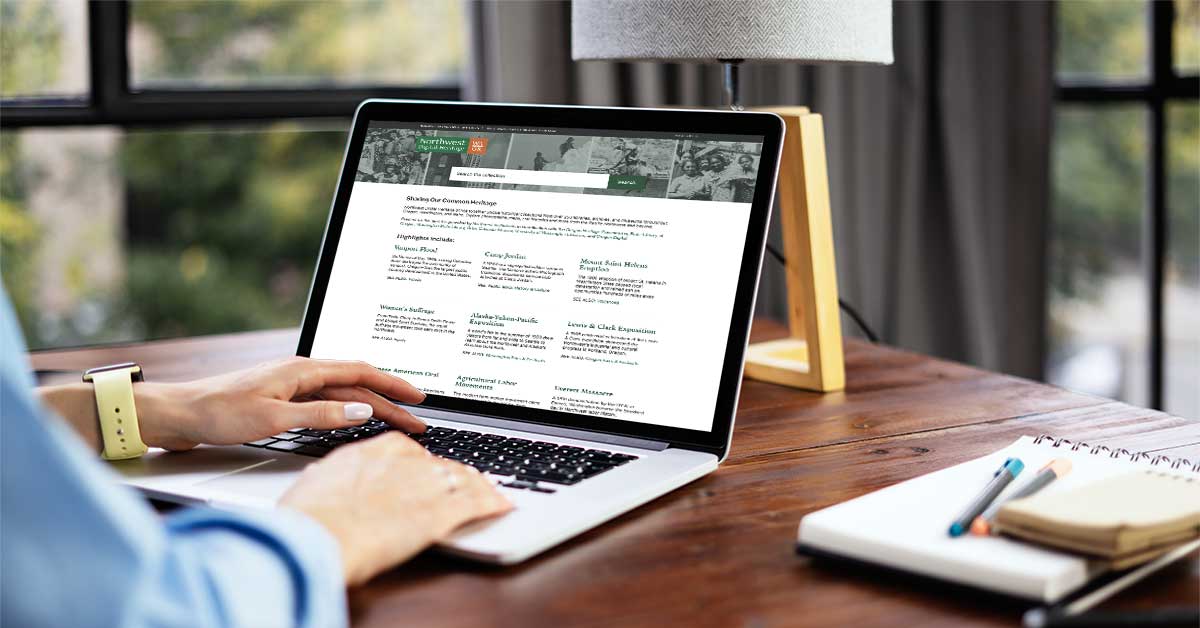
Northwest Digital Heritage (NWDH) is a shared collection discovery portal facilitated via a consortium-style model. For our purposes, a consortium in this context is a program or organization that connects isolated collections content across multiple repositories. The consortium then presents the previously disparate collection content as a cohesive online resource to global audiences hungry for centralized history, art, and culture.
By uniting libraries, archives, and museums, a consortium can amplify a collection’s cultural reach far beyond what a single institution could achieve alone, and it offers a more complete historical picture.
NWDH has the added benefit of also serving as a great equalizer. By providing free portal participation and technical support, NWDH empowers small institutions to easily share data on a platform built to magnify their reach.
What’s a Shared Discovery Portal?
A shared discovery portal is a centralized platform that harvests and aggregates online collection data from multiple institutions, delivering those materials in a standardized, cross-searchable format. Instead of requiring users to search each institution’s website separately, a shared portal gives researchers, educators, students, and the public one access point for discovering related materials across many repositories.
For a deeper dive into the shared discovery portal contributor experience, check out Power in Partnerships: The Discovery Portal on Lucidea’s Think Clearly Blog. Or watch our April 2026 webinar, The Partnership Blueprint for a Collaborative Discovery Portal.
Technical Flexibility and Autonomy
The greatest advantage of the NWDH-style model is autonomy. Partnering institutions keep their existing, separate Collections Management Systems (CMS) exactly as they are. There is no need to merge databases, migrate software, or grant outsiders direct access to internal servers. Instead, the collection metadata is periodically gathered and integrated into the central portal.
Depending on the technical setup, data harvesting by a consortium can happen in one of three ways:
- OAI-PMH Protocols: Automated, scheduled data harvesting directly from an online CMS.
- Consortium Triggers: Manual data pulls initiated by the network administrators.
- CSV Imports: Flat-file uploads designed for partners lacking traditional, web-facing collections software.
By offering a CSV import pathway, consortia lower the technical barrier to entry for underfunded museums, archives, and historical societies. NWDH is one such consortium, as they accept CSV files from approved contributors.
Spotlight on Northwest Digital Heritage
The NWDH consortium is specifically designed to deliver centralized Northwest history and offer equal opportunity to contribute regardless of an institution’s size or CMS. Launched in 2021, NWDH seeks to increase accessibility to the Pacific Northwest’s history and culture by supporting libraries, museums, and local communities with their digital collection needs. And they do so without charging contributing institutions.
The consortium thrives on a foundation of joint state leadership. It’s co-led by three major cultural agencies:
- The Washington State Library
- The State Library of Oregon
- The Oregon Heritage Commission
This centralized management structure provides the leadership framework and baseline funding needed to keep a multi-state network operational. The robust administrative backing also allows the program to grow at a massive scale. As of May 2026, NWDH boasts 293 contributing institutions across Oregon and Washington. Together, they provide public access to nearly 1.3 million records, seamlessly marrying metadata with digital assets.
What it Takes to Build a Consortium
Sustaining a program of this magnitude requires a highly structured ecosystem behind the scenes. To run a platform capable of supporting hundreds of distinct repositories, a consortium must secure and maintain:
- Funding & Infrastructure: Sustained financial backing and a stable institutional home.
- Technology: Enterprise-grade software and a scalable technical architecture.
- Human Capital: Dedicated personnel with technical and collection expertise.
- Frameworks: Unified data standards and (usually) a representative governing body.
NWDH offers a useful example of what this work looks like in practice. In this series, we’ll review NWDH’s inclusive contributor model, the funding and staff capacity required to run a platform that supports access to nearly 300 institutional collections, and the benefits and challenges present for this consortium model.
Want to learn more? Please join Rachael Cristine Woody for an informative new webinar, A Shared Collection Discovery Portal Case Study: Northwest Digital Heritage, on Wednesday, July 29, 2026 at 11 a.m. Pacific, 2 p.m. Eastern. Register now to reserve your seat!


0 Comments