
Lucidea’s Lens: Knowledge Management Thought Leaders
Part 125 – Göran Roos

Stan Garfield
 Göran Roos, originally from Sweden, now lives in England. He was co-founder of Intellectual Capital Services Ltd. (ICS), a London-based strategy consulting firm and think tank in the fields of innovation management, value measurement, strategy and management of intellectual capital, and strategic learning experiences. Göran is a pioneer in the intellectual capital movement
He is the prolific author and co-author of over three hundred books, book chapters, papers, and articles on Intellectual Capital, Innovation Management, Strategy, and Industrial Policy, many of which have been recognized with awards. He has around 14,000 Google Scholar citations. His specialties include strategy; innovation management; and industrial, innovation and research policy.
Here are definitions for five of Göran’s specialties:
- Innovation: The process by which an idea is translated into a good or service for which people will pay.
- Intellectual capital: The sum of everything everybody in a company knows that gives it a competitive edge. A metric for the value of intellectual capital is the amount by which the enterprise value of a firm exceeds the value of its tangible (physical and financial) assets. It includes human, structural, and relational capital.
- Research: Creative and systematic work undertaken to increase the stock of knowledge. It involves the collection, organization, and analysis of information to increase understanding of a topic or issue.
- Strategy: A set of guiding principles that, when communicated and adopted in the organization, generates a desired pattern of decision-making. The way that people throughout the organization should make decisions and allocate resources to accomplish key objectives. A strategy provides a clear roadmap that defines the actions people should take (and not take) and the things they should prioritize (and not prioritize) to achieve desired goals.
- Value measurement: The process of quantifying the benefits of a product, service, or business component to assess its contribution to overall organizational objectives.
Göran created the following content. I have curated it to represent his contributions to the field.
Books by Göran Roos
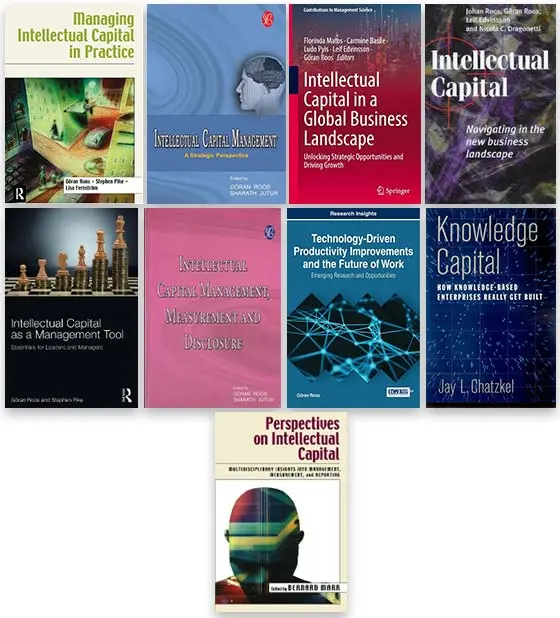
Evaluating Intellectual Capital and Measuring Knowledge Management Effectiveness

Intellectual Capital and Knowledge Management Effectiveness
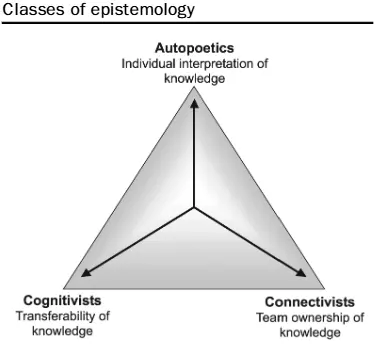
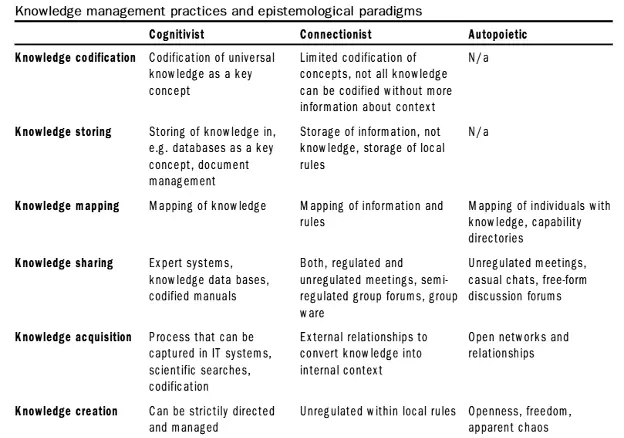
Three cognitive distinctions of knowledge creation
- Cognitivist – Cognitivists consider the identification, collection and central dissemination of information as the main knowledge development activity. Organizations are considered as open organizations that develop increasingly accurate pictures of their pre-defined worlds through the assimilation of new information. Knowledge is developed according to universal rule, hence the context of the incoming information is important.
- Connectionist – There are many similarities here to the cognitivist viewpoint but a difference being that there are no universal rules. As rules are team-based and vary locally, organizations are seen as groups of self-organized networks dependent on communication. The connectionists believe that knowledge resides in the connections and hence focus on the self-organized dispersed information flow.
- Autopoietic – Here the context of information inputs is unimportant; it is seen as data only. The organization is a system that is simultaneously open (to data) and closed (to information and knowledge). Information and knowledge cannot be transmitted easily since they require internal interpretation within the system according to the individual’s rules. Thus autopoietics develop individual knowledge, and respect that process in others.
Measuring the Impact of Knowledge Management in Companies
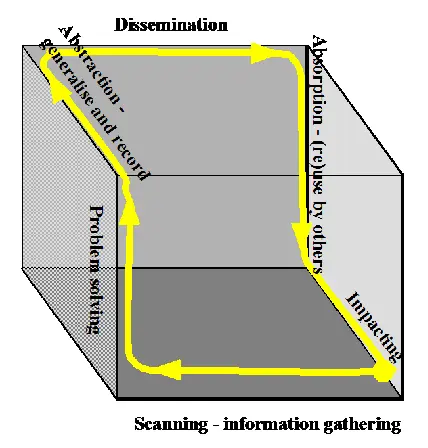
Max Boisot’s 6-step social learning cycle. The steps are scanning, problem solving, abstraction, dissemination, absorption, and impacting and are shown below.
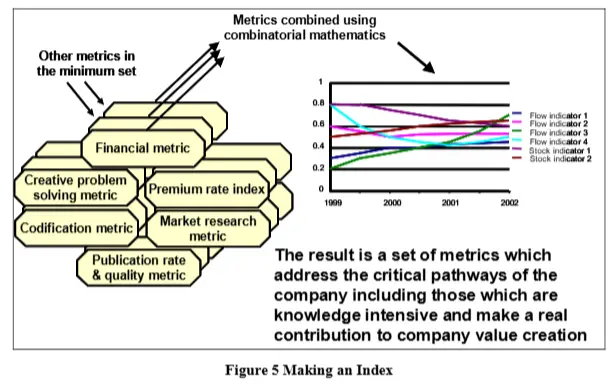
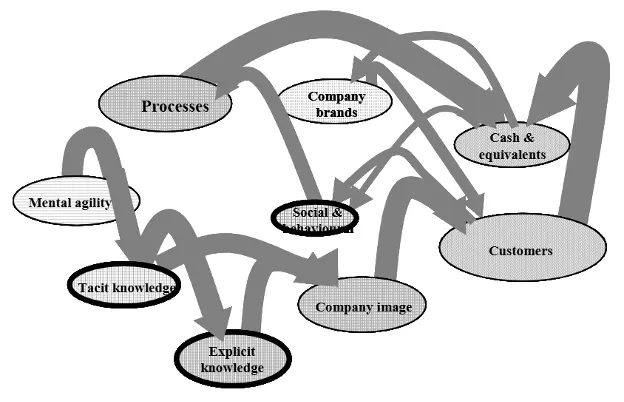
 Conceptual map generated by the ICS Navigator process. The size of the oval represents the importance of the static resource while the thickness of the arrow represents the importance of the transformations between the resources.
Searching for KM software that enables you to curate, manage, and share organizational intelligence in a single venue? Get in touch to learn about Presto!
Stan Garfield
Please enjoy Stan’s blog posts offering advice and insights drawn from many years as a KM practitioner. You can also download a free copy of his book, Profiles in Knowledge: 120 Thought Leaders in Knowledge Management, from Lucidea Press, and its precursor, Lucidea’s Lens: Special Librarians & Information Specialists; The Five Cs of KM.
Learn about Lucidea’s Presto, SydneyDigital, and GeniePlus software with unrivaled KM capabilities that enable successful knowledge curation and sharing.
**Disclaimer: Any in-line promotional text does not imply Lucidea product endorsement by the author of this post.
Never miss another post. Subscribe today!
Similar Posts

The KM Mentor, Part 8: Top Knowledge Management Trends 2026
The intersection of AI and KM allows knowledge managers to inject the best KM into high-priority organizational AI initiatives; Stan Garfield’s review of 8 Top KM Trends 2026.

The KM Mentor, Part 7: What Can a Knowledge Manager Accomplish Without a Budget?
No budget for KM? Stan Garfield shows how 20 KM components and the Five Cs let you demonstrate value using only time and effort, and build the case for investment.

The KM Mentor, Part 6: The 10 Biggest Mistakes New Knowledge Managers Make
KM expert Stan Garfield offers his analysis of the 10 strategic mistakes it’s easy to make as a new knowledge manager, with practical options to proactively prevent them.

The KM Mentor, Part 5: The First 90 Days
Responding to the question “What should I do in my first 90 days as a knowledge manager?” expert Stan Garfield lists practical suggestions that can set you up for success.
Leave a Comment
Comments are reviewed and must adhere to our comments policy.
0 Comments