


This is the first post in The KM Cure, a series about critical organizational challenges that can be addressed using knowledge management principles and proven practices.
The first installment addresses one of the most common and costly challenges: retaining organizational knowledge in the face of a departing workforce.
The Challenge
The challenge is how to cope with workforce departures, which result in the loss of more than just data and documentation. More significant is the loss of judgment, know-how, and connections. The resultant loss of knowledge has accelerated due to retirements, role changes, increased use of temporary workers, mergers and acquisitions, reorganizations and restructuring, layoffs, job churn, and illness.
Experts who previously brought wide-ranging perception, judgment, and experience to real-time decision-making are gone, and there may be no one left who can fill the gap.
How Does Knowledge Loss Occur Across Different Business Functions?
The impact of lost knowledge can be felt across departments, functions, and businesses. Here are eight examples.
Software Development
Maintaining and enhancing existing systems depends on the developers’ knowledge of how and why the software was designed, developed, deployed, and debugged. Many organizations still depend on legacy software for which there is little or no current understanding of how to maintain it. When it crashes, there may be no one left who can fix it.
Engineering and Manufacturing
Knowledge of how certain products and systems were created, how specific machines or plants function, and the details of operating processes are essential to keep everything running smoothly. For example, after the engineers who designed the Saturn rocket retired, it became impossible to build new ones.
Supply Chain
Business processes typically depend on a process owner who understands the inputs and outputs, the key people and roles involved, and the required sequence of steps. If the process owner departs and an exception occurs, the process can stop working.
Service and Repair
Over time, good technicians develop ad hoc diagnostics, hacks, and techniques that may not be written down. These methods require a specialized combination of experience, context, and intuition to apply effectively. When veteran technicians leave, their junior replacements may be unable to fix problems that previously were readily resolved.
Research
New efforts that build on previous ones depend on continuity. Staff turnover may result in the inability to exploit existing research. Approval, regulatory, and legal obstacles may become much harder to overcome.
Sales
Cumulative knowledge of customers, partners, and competitors is needed to ensure ongoing sales and customer satisfaction. Loss of this knowledge can disrupt the order pipeline and result in lost customers and partners.
Law
When lawyers with knowledge of past case histories and unique client guidelines leave their firms, it may be difficult to maintain trust and provide consistent legal strategy for existing clients.
Knowledge Management
Historically, KM programs have come and gone, depending on the state of the business, the presence of sponsors, and reorganizations. Each time a KM program is terminated, it is likely to be restarted later because the underlying need for knowledge management has not gone away. When the inevitable new initiative is launched, knowledge of what was done previously is typically gone, which leads to reinventing the wheel.
What Are the Root Causes of Knowledge Loss?
Lost knowledge typically results from one or more of these causes:
- There is limited or no planning for how to retain knowledge before employees leave. The organization is blindsided by departures and is unable to cope with the effects.
- No structured processes for capturing and transferring knowledge are in place. There may be some attempts to do this, but they are hit-or-miss and inconsistent.
- Desperate, last-minute attempts to get departing employees to write down everything they know are woefully inadequate. A very limited amount of knowledge may be captured, but it does not prevent the problems that will ensue.
The Costs of Inaction
The costs of leaving knowledge retention unfixed include:
- The organization loses the ability to perform key tasks that were once routine. The time to complete tasks and the overall risk level increase, quality decreases, and morale suffers.
- Errors, failures, and reduced quality result from processes not being followed properly.
- Employees are frustrated when they can’t find out how to perform tasks, why past decisions were made, and where key materials and documents are located.
- Customers are lost due to impaired sales and service.
- Competitive advantage is reduced due to negative impacts on research, engineering, supply chain, and other key functions.
An Ideal State: 6 Conditions for Knowledge Retention
In organizations that implement effective knowledge retention strategies, the following conditions are in evidence:
1. There is a dedicated community of practice for each topic of importance to the organization, everyone belongs to at least one community and pays attention to its discussions, and there are active leaders for all communities. All community contributions and community discussion threads are preserved in an archive.
2. Experts regularly develop training courses on their specialties. These are regularly maintained and made readily available.
3. Desirable incentives are offered for creating personal guides to processes, contacts, and content. Help is provided for doing so.
4. Video interviews are used regularly to collect stories, instructions, and tips. These are posted in easily accessible repositories and are promoted in the relevant communities.
5. Experts are assigned apprentices and mentor them until they can perform as well as, or better than, their mentors. A program is in place to lead and support this effort.
6. Retirees are allowed to continue participating in communities as long as they can contribute. Incentives are offered to the most valuable retirees to remain active.
Next Steps: What Can Be Done to Prevent Knowledge Loss?
There are plenty of steps you can take to begin retaining knowledge before it’s too late.
Leverage the Experience of Experts
You can start by reflecting on the approaches listed in the ideal state and implement as many as practical for your organization.
You can also apply proven knowledge transfer practices such as those presented in my recent Lucidea webinar, The Importance of Organizational Knowledge Retention.
Use SNA, or Social Network Analysis, to identify the critical go-to people in the organization and start working with them to both capture their knowledge and provide incentives for them to remain in the organization.
Explore Using AI to Capture Knowledge
Use Generative AI to create searchable knowledge resources based on experts’ documented guidance, interviews, and training materials. Ensure that key knowledge is replicated, including, but not limited to:
- How to perform specific tasks
- Rules of thumb, tricks, techniques, and what to avoid
- Rationale for key decisions
- Identities of others with relevant expertise and experience
Measure (and Encourage) Adoption and Participation
Measure the percentage of identified experts who have recorded interviews and training, written white papers and how-to guides, and served as mentors to apprentices. Publish and disseminate this information and act as necessary to increase the percentage to an acceptable level.
Measure participation in the incentive program. Ask those receiving rewards to tell stories of how they are helping to retain knowledge. Solicit feedback on the incentive program and act on this feedback to improve the program.
Additional Resources
For additional suggestions, see the related blog post, webinar, and infographics below.
- Read: Knowledge Retention: How to Deal with a Departing Workforce
- Watch: The Importance of Organizational Knowledge Retention
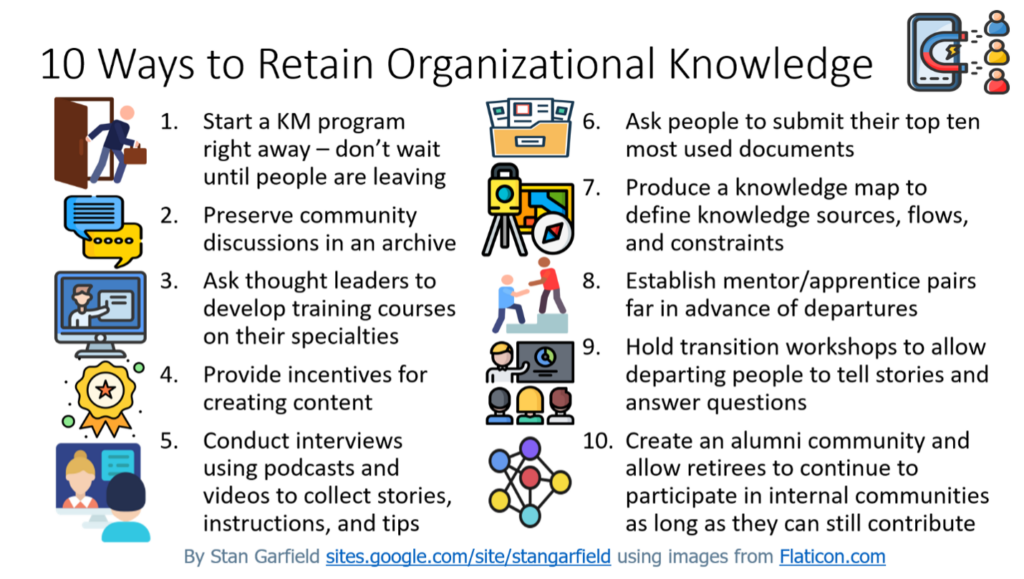
10 Ways to Retain Organizational Knowledge: This infographic summarizes practical actions organizations can take to preserve critical knowledge before employees leave.
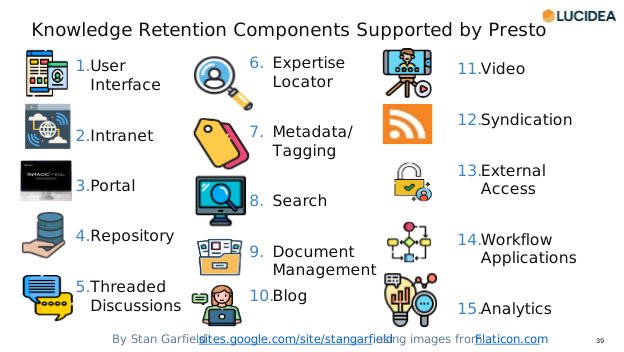
Knowledge retention is ultimately a people-and-process challenge, but the right systems can help make captured knowledge easier to organize, preserve, and reuse.
Knowledge Retention Components Supported by Presto: This infographic shows how knowledge retention activities can be supported through a structured knowledge management platform.







0 Comments