
Lucidea’s Lens: Knowledge Management Thought Leaders
Part 126 – Kent Greenes

Stan Garfield
Kent Greenes, now retired, dedicated his career to helping teams, organizations and communities unleash the power of their collective learning and knowledge. Recognized as one of the pioneers in the field of KM, his specialties are fast learning and performing, knowledge management, culture change, and transformation.
Kent worked in BP for 17 years, where he initiated and directed the Virtual Teamwork Program. He joined SAIC as their CKO in 1999 and built a highly regarded KM consulting practice in the public and private sectors. He led their business transformation and introduced Six Sigma. Kent started his own consulting practice in 2006. He led The Conference Board’s Knowledge & Collaboration and Change & Transformation Councils of cross-industry leaders.
Here are definitions for five of Kent’s specialties:
- Collaboration: Interacting with peers and colleagues to exchange ideas, share experiences, work together on projects, and solve problems.
- Fast Learning: Learning before, during and after everything that is done. With routine comes speed, and learning with speed delivers high performance. Methods include peer assists (learning before doing), action reviews (learning while doing), and After Action Reviews (learning after doing).
- Culture Change: A process by which an organization encourages employees to adopt behaviors and mindsets that are consistent with the organization’s values and goals. It may be necessary to better align the behaviors of employees with current and future business objectives.
- Knowledge Retention: Methods of capturing or maintaining access to the knowledge of workers leaving an organization due to new jobs, retirement, promotion, relocation, and role changes; temporary work, contracting, consulting, and outsourcing; mergers, acquisitions, consolidations, and reorganizations; changes in strategy, focus, or specialty; workforce reductions; short-term job mentality; disillusionment; death, illness, and care giving.
- Transformation: The cultural, organizational, and operational change of an organization, industry, or ecosystem through a smart integration of digital technologies, processes, and competencies across all levels and functions in a staged and strategic way.
Kent created the following content. I have curated it to represent his contributions to the field.
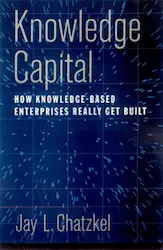
Books by Kent Greenes
- Chapter 15: Knowledge Management Is about Change
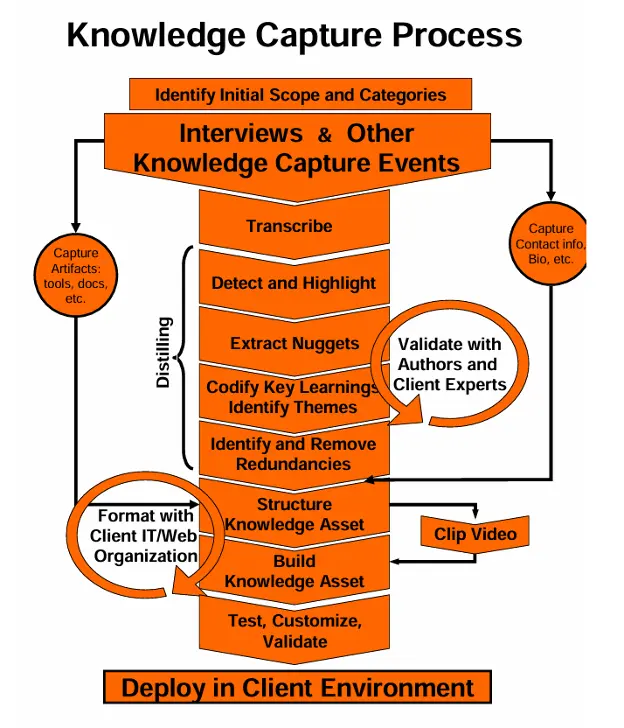
10-Step Guide to Knowledge Capture
Peer Assist: Learning Before Doing
Here are some critical things to do to ensure a successful outcome of a peer assist:
- Define the problem or opportunity that you are facing and decide whether a peer assist is the most appropriate process.
- Write and disseminate a brief description of your need to peers, giving them the chance to self-select for participation.
- Look for diversity, that is, people who will help your team confront the problem from different perspectives.
- As soon as possible, identify people who can participate on your selected dates—fitting into their schedules is critical.
- Identify an experienced facilitator who understands the learning process.
- Design the event to ensure plenty of time to reflect.
- Allow the peer-assist team members time as a group during the session to analyze their findings.
- Ensure the key lessons and good practices shared during the session are captured. This may require some follow-up work to gather sufficient detail for those who did not participate.
- Agree to a set of actions.
- Make your findings accessible to others outside the group.
Searching for KM software that enables you to curate, manage, and share organizational intelligence in a single venue? Get in touch to learn about Presto!
Stan Garfield
Please enjoy Stan’s blog posts offering advice and insights drawn from many years as a KM practitioner. You may also want to download a free copy of his book, Profiles in Knowledge: 120 Thought Leaders in Knowledge Management from Lucidea Press, and its precursor, Lucidea’s Lens: Special Librarians & Information Specialists; The Five Cs of KM. Learn about Lucidea’s Presto, SydneyDigital, and GeniePlus software with unrivaled KM capabilities that enable successful knowledge curation and sharing.
**Disclaimer: Any in-line promotional text does not imply Lucidea product endorsement by the author of this post.
Never miss another post. Subscribe today!
Similar Posts

The LEXICON Framework Part 4: Integrate with Existing Systems
Stan Garfield explores practical ways to embed KM tools into the platforms your team already uses reduces friction, boosts adoption, and makes organizational knowledge easier to access.

The LEXICON Framework Part 3: 10 Ways to eXplain the Value of Knowledge Management
KM expert Stan Garfield offers 10 practical ways to explain and prove the value of knowledge management using Clare Bilobrk’s LEXICON framework.

The LEXICON Framework Part 2: Empower Champions of KM
In part two of our LEXICON series, we explore how empowering KM champions can strengthen knowledge management adoption. Discover practical strategies to identify champions, define their roles, and connect them across your organization.

The LEXICON Framework Part 1: Link KM to Daily Workflows
Stan Garfield explores the LEXICON framework for KM, sharing 16 strategies to embed knowledge management into daily workflows effectively.
Leave a Comment
Comments are reviewed and must adhere to our comments policy.
0 Comments