

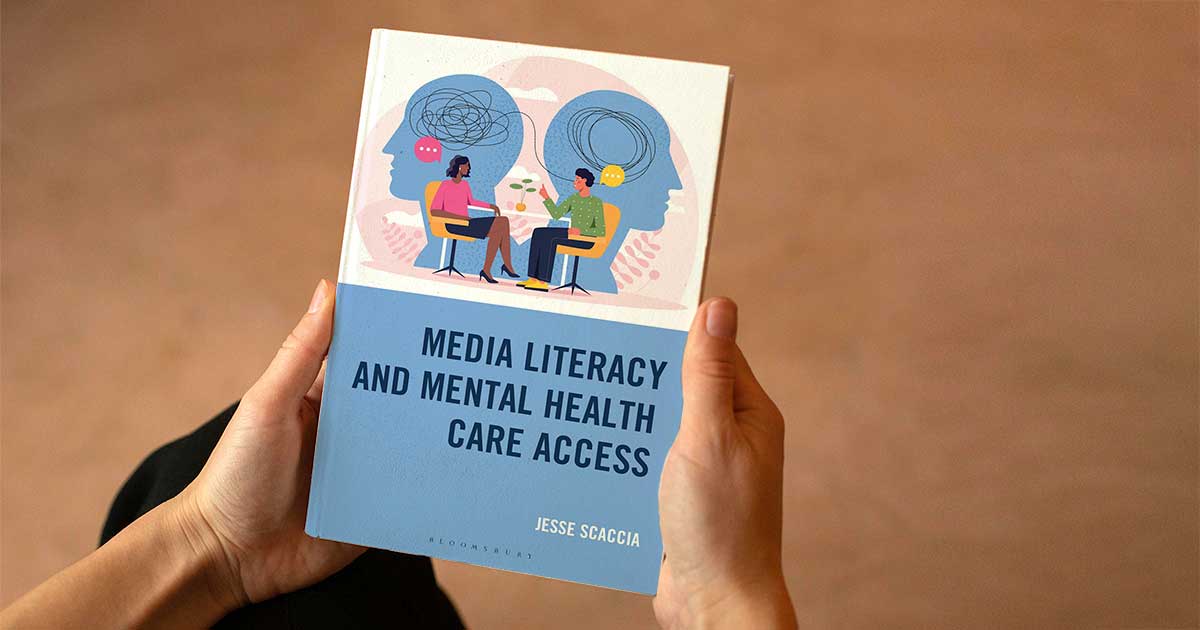
Jesse Scaccia is the author of Media Literacy and Mental Health Care Access, available now from Bloomsbury. His work explores how media literacy can help young adults navigate mental health information and access care, offering a valuable perspective for educators, librarians, and information professionals.
For school librarians, the topic connects closely to the work of helping students find reliable information, think critically about the media they encounter, and apply those skills in practical, real-world contexts.
In the interview below, Jesse discusses the research behind his book, the relationship between media literacy and health literacy, and the challenges and skills required for young adults navigating sensitive information online.
1. Please introduce yourself to our readers.
Hello everyone! My name is Jesse. My PhD is in Media Communication from Colorado State University. I teach media literacy and journalism courses at Fresno State, and I have also taught personal narrative writing classes at Valley State Prison and Central California Women’s Facility.
Along with media literacy and mental health care access, my research focuses on news deserts and the life without possibility of parole sentence. Outside of work, I do a lot of yoga, appreciate Latin dancing, and I love the Knicks and house music.
2. Briefly summarize Media Literacy and Mental Health Care Access.
The book starts by giving overviews of what we know about (a) promoting health related messages in a way that people actually hear and act on, (b) current young adult mental health in America, and the role media has played in the young adult mental health crisis, and (c) the media literacy movement, and how media literacy has been shown to change people’s actions.
Then it dives into my original research, where I interviewed young adults and people who promote mental health care, to find out how they can best hear each other. The original research is guided by the Theory of Planned Behavior, which health communicators have long used to shape messages in ways that are proven to work.
3. Why did you decide to write this book?
I decided to write this book because I knew that many of my students were suffering, mentally and emotionally. I also knew that mental health care was out there for most of them. Why weren’t they accessing it? As someone in the media literacy space, I wondered if there might be something off in the way that we’re letting young adults know that mental health care is available to them. My hope was that through this book, we could build a better bridge between those in need and the care that’s often just a call away.
4. In many schools, librarians often teach media literacy skills. What recommendations do you have for school librarians teaching media literacy?
I recommend that librarians see media literacy almost like rice, in that it pairs well with things but isn’t as exciting on its own. A lot of media literacy education is pointed toward things like spotting misinformation, which is important, but can feel abstract and less directly relevant to people’s lives. When we pair media literacy with health literacy, for example, we start to see it leading to people accessing health care more and getting better care. When we pair media literacy and civic education, we are creating more powerful and effective community leaders. So, I encourage librarians to think of media literacy as tools and skills that come alive when they’re pointed in a practical direction.
5. What would you like school librarians to know about the connection of media literacy to mental health care access?
Media literacy skills are absolutely critical to being able to access mental health care. A person needs to be able to do research about what they’re experiencing and research on where they can get help. It’s through media that people increase health literacy—including about their conditions, and potential treatment options—which has been shown to lead to numerous better health outcomes. Librarians are very well positioned to help sick people reach care, by teaching them how to use media to access and get the most of that care.
6. What are two things you hope all readers take away?
Number one, that there’s still nothing like face-to-face communication. Digital marketing campaigns and billboards can help get a message out on a surface level, but for something as personal and sensitive as talking about mental health care, young adults are much more receptive when that care is communicated through someone trusted, like a peer or professor.
Second, it’s that we all need to be our own health and mental health advocates. That starts with understanding our conditions – what causes them, what they look like, and the different approaches to healing them. Then, armed with that information, we need to be assertive in asking questions, and in advocating to health care providers to give us the care we need.
7. Is there anything else you would like to share?
We all need help sometimes. People dealing with mental health issues can have a hard time reaching care because their conditions can create functional limitations to accessing it. For example, having anxiety can make someone too anxious to call their health care provider, or depression can leave someone unmotivated.
Sometimes a friend or family member may need the help of someone with higher media literacy skills (like you) to guide them through the web that leads to help.
We can help change—and sometimes even save—each other’s lives by helping them access care, and I think it’s something we should do more often.






0 Comments