

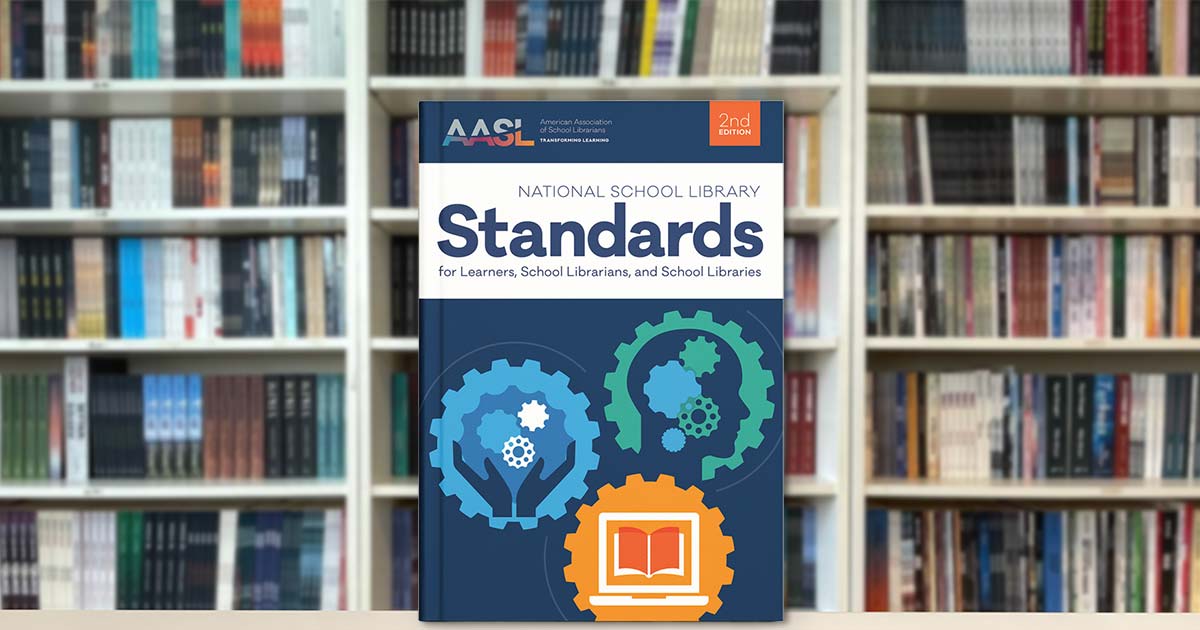
Amanda Kordeliski is the President of the American Association of School Librarians (AASL). She says that school libraries are her “happy place”; you will see why in my interview with her below.
Please introduce yourself to our readers.
My name is Amanda Kordeliski, and I currently serve as the AASL President. This is my 16th year in school libraries. I started as an elementary librarian but quickly discovered that my sweet spot was secondary. I have worked in elementary, middle, and high schools, as well as an alternative high school, so I have run the gamut of library environments.
The director of our program in my school district retired in 2020, and I decided to switch jobs. I became the Director of Libraries for my district on July 1, 2020. That is also when I got close to starting my journey on the AASL Board. I had chaired and served on many committees, and I was eventually asked to run for Director-at-Large. I lost the first time, ran again, and won. Then I was asked to run for President. I have been on the board for five years now, between my Director-at-Large term and my three-year presidential cycle. I am based in Oklahoma, and school libraries are truly my happy place.
Will you share some information about the American Association for School Librarians?
We are a division of the American Library Association (ALA), and our focus is really on instruction. We focus on showcasing that librarians are teachers—often master teachers—who have expertise in technology, reference, and searching. We hold the key to unlocking students’ potential and their creativity.
In libraries, everything doesn’t follow a prescribed pattern; we look to serve readers and learners where they are. If where they are is only graphic novels, great—we’ve got those. If they want to come in and work in the Makerspace on things that are literacy-adjacent, we welcome them. We want the library to be a safe place for everyone, whether they are a “huge reader” or not.
What are some goals for your time as president?
I have big “pie-in-the-sky” goals, but my realistic goals involve opening up our communication to be more responsive to user needs. We had a massive shift when everything went remote in 2020, and we are still picking through the results. For example, we found that while webinars worked great, the market is now oversaturated.
My hope during my presidential year is that we identify the pandemic-era developments that are beneficial and not overly time-consuming so we can elevate those voices. For the things we were doing just to survive, we can let those go and move back to best practices.
We have done a lot of triaging lately, and I feel like this is the first year we have had the opportunity to look forward rather than just reacting to policy. While we are still fighting certain issues, I want my presidency to be proactive. I want to focus on what AASL can do for librarians rather than just issuing responses to bad bills or censorship issues. More proactive, less reactive.
What changes are you seeing in school libraries, and how does AASL support those changes?
There are a couple of big trends right now. During COVID, librarians were elevated because we were the ones who could handle all the technology. Since then, some of those librarians have had to fight for their positions. Administrators and principals don’t always understand the full scope of what we do; they sometimes think it would be better to have a “tech person” than a “library person,” but if you hire a librarian, you get both.
We are advocating for districts that are still fighting for certified, fully staffed librarians in every school. At the same time, we support districts that already have those resources and want to grow. It is a balancing act because every state functions differently.
I am also encouraged by an unintended impact of “no phones in schools” laws, such as the one in my state. We have seen a huge boost in circulation. At a high school this morning, I saw kids talking to each other instead of scrolling on social media. Our board game library is active again. We want to show librarians how to replicate that success—showing that when the distraction of the phone is gone, students are interested in engaging. We support librarians wherever they are, whether they are just trying to keep the doors open or running high-tech audio labs and makerspaces.
What most excites you about school libraries today?
The possibilities are endless. I spent 12 years in a school library before moving into this position, and I never had a day that was the same as the one before. The library touches every subject and grade area.
I am also seeing people recognize the importance of media literacy. It is essential to develop good consumers of information, especially with the “AI slop” currently on social media. Teaching kids what to look for, what to be wary of, and how to identify fakes is a great goal. I think universal media literacy is a sign of real progress.





0 Comments