

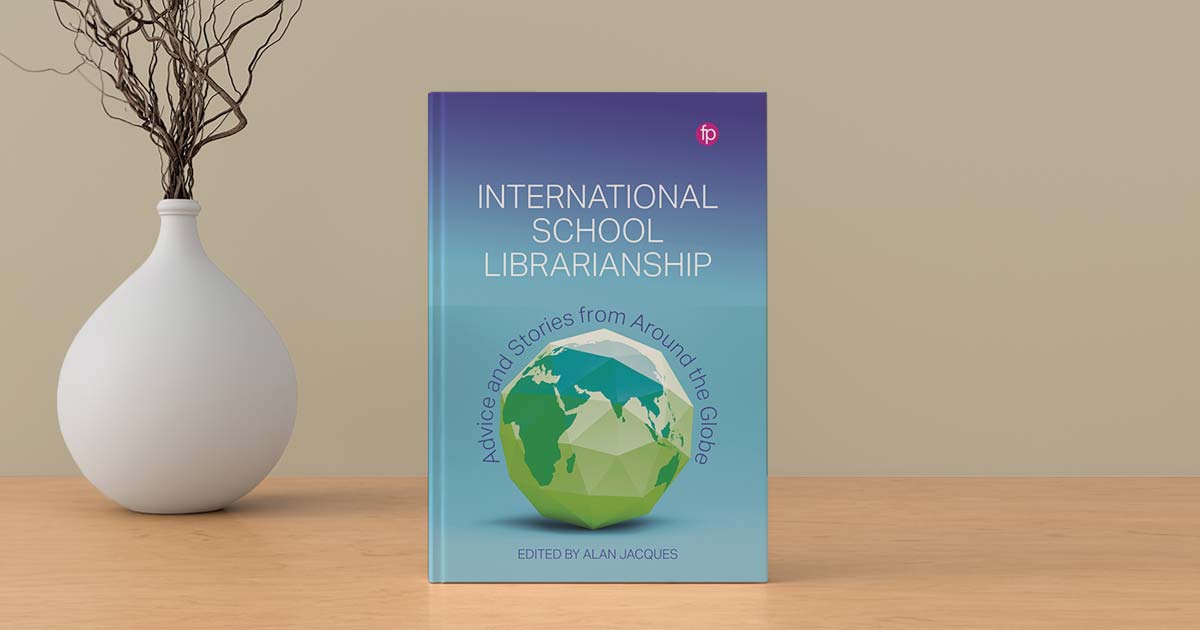
Alan Jacques is the editor of International School Librarianship: Advice and Stories from Around the Globe. His book features narratives written by 13 international school librarians, surfaces best practices, and bridges the academic, professional, and personal elements of an exciting and multicultural environment. My interview with him is below,
Please introduce yourself and describe your background for our readers.
I am an international school librarian, a role I have held for the past 20 years. International schools are primarily private or nonprofit institutions spread globally in a loosely connected network. They predominantly serve expatriate families who are living and working outside of their home countries.
It is an incredibly exciting and multicultural environment. You have the privilege of working alongside faculty and families from dozens of different backgrounds. Furthermore, these schools are typically well-funded, which generally makes the work-life balance and overall professional experience highly satisfying.
Could you briefly summarize your book, International School Librarianship: Advice and Stories from Around the Globe?
The book is a collection of narrative essays that I have been curating over the last few years. I’ve gathered together 13 great librarians from around the world, people who are senior in their field. What I find particularly fascinating is that while the authors provide excellent geographical and cultural representation, most of them are currently working on a continent different from their country of origin.
What truly sets this book apart is that it moves away from traditional, purely academic structures. Instead, it leverages the lived histories of these librarians as a gateway to discussing best practices. Each chapter’s foundation is a story from inside that librarian’s library, and we then ground those narratives in the research and theories of the library world. It bridges the academic, the professional, and the deeply personal, resulting in an academic text that is warm and profoundly human.
Published by Facet Publishing in the UK and distributed by the ALA bookstore in America, it represents the first book in a long time to focus exclusively on international school libraries.
What motivated you to edit this book?
Over my 20 years in the field, I established a large global network for international school librarians. In interacting with this global community, I realized that while our day-to-day environments are vastly different, we face incredibly familiar challenges.
In an effort to deepen our professional conversations, the concept of the book emerged naturally. I volunteered to curate and edit the project to ensure it maintained a strong, cohesive editorial stance. Every essay follows a deliberate structure so that readers always know where they are and can easily walk away with actionable insights.
Admittedly, the process humbled me. As a librarian who has purveyed books for two decades, I was embarrassed by how little I actually knew about the production side. It requires an extraordinary amount of labor from massive teams. Beyond the authors, the publishing house provided incredible support with fact-checking, copyediting, and refinement. It was a massive eye-opener.
What are the two main takeaways you hope readers gain from the book?
The first is the realization of how similar we are in our differences. For example, one compelling essay features a librarian in Kenya who transitioned from a university library to a school library. He writes with immense vulnerability about the culture shock of navigating professional boundaries with minors, and the emotional learning curve required to adapt his interactions.
That stands in stark contrast to my own essay, which is a more provocative look at the culture of reading. I argue that schools are inadvertently damaging reading by treating it strictly as a skill and focusing purely on literacy metrics. Literacy is important, but reading is a sociocultural and historical phenomenon, and that aspect can only be learned through personal experience.
Ultimately, despite how incredibly diverse and distinct these 13 essays are, the overarching takeaway is the commonality of the human experience within our profession.
You mentioned that librarians share many commonalities. What are the most pervasive shared experiences in your field?
To look at it through a more critical lens, school librarians globally share systemic challenges: budget constraints, a lack of administrative support, and a general misunderstanding from teaching staff regarding what a modern library actually does. These struggles are identical whether you are in Cuba, China, Durban, or Dubai. Part of the purpose of this book is to offer solidarity, but more importantly, to share the best practices used to successfully navigate these limitations.
A major driver of these issues is that schools—whether private operations or state-funded—have increasingly adopted corporate business practices, such as Key Performance Indicators (KPIs). This puts immense pressure on educators to produce quantifiable metrics. However, the true value of a library is qualitative and sometimes outright denies measurement.
Everyone has a fond, nostalgic childhood story about a library, so we collectively understand their intrinsic value. Yet, in an efficiency-driven educational landscape, qualitative worth is difficult to measure. This has left libraries vulnerable, particularly when competing against rapid technological tools that look faster and better at face value. In reality, a library, much like reading itself, is an integrated cultural phenomenon whose effects defy simplistic quantification.
How can international school librarians join your network to support one another?
Our WhatsApp group is now roughly five years old and has grown to include over 800 members worldwide, and it operates beautifully as a global triage desk.
 Because WhatsApp is a short-form, immediate medium, it allows a librarian to pick up their phone and get an answer to an urgent problem in real time. Our membership spans every time zone, so there is always someone online to offer a second opinion.
We do maintain one strict caveat: membership is exclusively reserved for school library personnel. We decline applications from classroom teachers and university librarians because safeguarding this specific peer-to-peer culture is vital. However, if you work in a school library—regardless of whether you hold formal qualifications—you are welcome in our community.





Thanks Lauren
It was great to meet you. You make blogging look so effortless, I’m jealous.
It has been a long and wonderful experience curating this collection of amazing people from around the world, and I feel that together we have produced something new and fresh.
Every essay is a personal story, an ‘aha’ moment from that author’s life – so each essay is personal and unique, but then filtered through a library theory or framework, so that we can all share in their learning. Readers come away from each essay with new techniques, that’s expected of good essayists, but more important is how those techniques are grounded in a personal and human understanding of who we are as a profession.
The book is officially out on June 18th…
Amazon
https://bit.ly/4uMPJc5
Facet
https://www.facetpublishing.co.uk/page/detail/international-school-librarianship/?k=9781783307609
ALA
https://alastore.ala.org/intschlib