

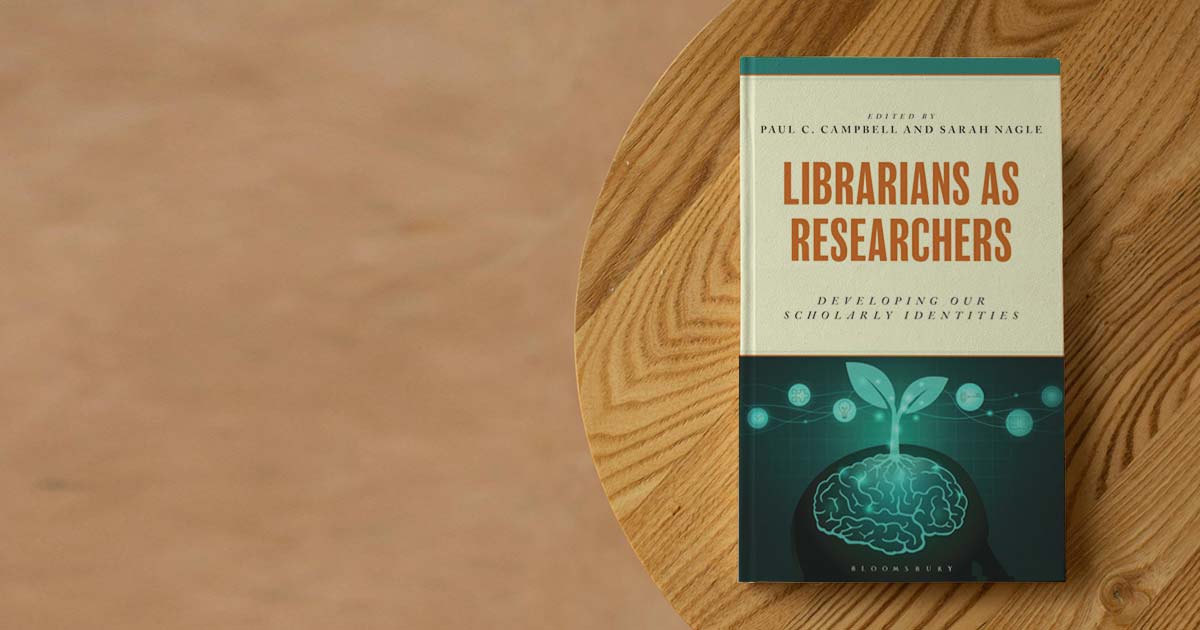
Paul Campbell and Sarah Nagle are co-editors of Librarians as Researchers: Developing Our Scholarly Identities. This book is useful for librarians interested in developing their own research agenda and participating in scholarly communication through publishing. No matter the type of library in which you work, thinking about your research output is important for the profession.
I recently had the chance to speak with them about the topics covered in their book, what motivated them to produce it, and advice for librarians and researchers. Our conversation is below.
Please start by introducing yourselves to our readers.
Sarah Nagle (SN): Hi, I’m Sarah Nagle. My job title is Creation and Innovation Services Librarian, and I work at Miami University in Oxford, Ohio. My job includes running a busy makerspace at our main library, King Library. A big part of that is working with faculty to incorporate the makerspace into their courses.
I am focused on library research, and my research interest is maker-centered learning. I do a lot with equity and diversity in makerspaces—all types of makerspaces. Currently, I am interested in how creativity and creative activities affect burnout in library work.
Paul C. Campbell (PCC): I am Paul Campbell, and I am an assistant professor at Kent State University Libraries. I have been in this position for about a year and a half now. My job is social science and assessment librarian, but prior to this job, I was at Ohio University in Athens as a social science librarian.
Even when I was at Ohio University, I did not have faculty status. I was administrative or professional staff. I became hooked on researching and producing literature because I felt it informed my practice and helped me engage with my users by reflecting on my process. Now, scholarship and research are essential for me in my new job.
My research interests are evolving because my job has somewhat shifted to include the assessment piece. I am starting to explore library assessment research—how to produce literature that assesses the effectiveness of my library.
Please briefly summarize Librarians as Researchers: Developing Our Scholarly Identities.
SN: Paul and I met as part of the Academic Library Association of Ohio as co-chairs of the Research and Publications Committee. We are obviously interested in doing library research—research in the field of librarianship itself.
As part of that group, we decided to do a webinar on librarians as researchers in their own right, as opposed to librarians supporting others’ research. Librarians provide services, and one of those services is helping others with research.
PCC: Librarians are often part of developing original research, especially in academic librarianship, often mandated by the tenure process—both Sarah and I are in tenure track or tenured positions where you have to do research or you do not have a job. Additionally, many librarians are driven to perform research because of their intellectual curiosity and passion for what they do. There are so many librarians doing amazing original research and publishing great work.
SN: We thought, let’s do a webinar and make it available to everyone, not just in ALAO, but nationwide. We put out a call for proposals and got about 25. We said, okay, maybe we’ll do a series instead of just a single webinar. We ended up doing a series of five webinars called “Librarians as Researchers.”
They were great webinars that generated a lot of interest, not just from the Ohio academic library community, but also from all across the U.S. Because of that interest, we realized there was a demand and need for this type of community and information. We thought, what about an edited volume? One thing led to another, and here we are, two and a half years later—and this edited volume has been published.
PCC: When we put out that call nationally for webinar content on how librarians develop their researcher identity—becoming researchers in their own right, not just supporting research—we were hoping we would get at least five proposals from which we could select three good ones. However, nearly all the proposals were excellent, and we had a really hard time deciding which five to select. We didn’t want to let the others go unseen.
Sarah and I had a follow-up meeting after we got the proposals, and we both, at the same time, said, “Maybe we should do a book.” It was a “great minds think alike” situation.
Therefore, we put together a book proposal. It was really a fun process to work with Sarah on this and with our authors. Our authors were fantastic, taking our feedback and making the minor modifications needed. I think we got robust points of view and content, both about the philosophy behind why we should be researchers in our own right, and about the practical how-to of doing research.
We see this book as something an academic librarian (or special librarian) wanting to do research on his or her own might use as a roadmap for how to do that.
Why did you decide to produce this book?
SN: I felt personally that I came into academic librarianship and had to learn for myself how to become a researcher. I started as a public librarian and then moved into academic librarianship. While I did some research-related things in my library school program, I did not necessarily learn how to do a lot of the research process.
When I got into a tenure-track academic librarian position where you have to complete so much research and scholarship within the first few years, I really had to learn things on my own. There was some community of practice available to me, but I wished I had more resources available as an early-career librarian.
That was also a motivator behind wanting to do this—to create more of a community around these topics for younger librarians or librarians who made the switch from positions that didn’t require research into positions that did, and found themselves being like, “Oh my gosh, where do I start? What do I do?”—because it can be very intimidating. I felt very motivated to help develop more resources for librarians who found themselves in that position.
PCC: I totally agree with what Sarah just said about starting my career as an academic librarian. I have only been in academic libraries, but nowhere in my master’s program did I have a “this is how you do research” class or training on research methodologies. I think that is a shared challenge for all types of librarians, and another reason why we really wanted this book out there.
So many other librarians have had similar experiences to Sarah and me. Often, librarians are left alone to try to figure out what scholarship is and how to engage in scholarly communication.
Another aspect is that in terms of having a researcher identity myself, I fully understand the pressures that the researchers I work with and support face. I understand their frustrations and experiences a lot better because I am also dealing with finding sources, doing literature reviews, and managing my citations—all of the things at which librarians excel. However, so many times, we do not learn to carry the project through; we are just there to assist at different parts of the research process.
Engaging in that research process alone or with other librarians really helps me understand the researcher process.
What do you see as librarians’ biggest challenge in developing their scholarly identities and how does this book help them navigate that challenge?
PCC: Librarians are not usually taught how to do research as part of their master’s program, and some librarian positions require research and output, while some do not at all. Another big barrier is time—time not to do your librarian job, but to actually sit down and do the literature review, try to find gaps in the literature, and develop some sort of new study.
This book is helpful in addressing those things because there are several chapters about developing a community of practice or support network within your institution. Readers could actualize those lessons and create a national or multi-institutional group of librarians resulting in a community of practice that, by the way, helps with accountability. If I say I am going to have this literature review done by October, and I have to report out to somebody, I am more likely to do it.
Also, there are a couple of chapters about the practical aspects, like getting IRB approval, which can be very intimidating for somebody who’s never done that before, or developing protocols. There is a chapter about how to do that. I think those are some ways in which this book may help librarians get into their researcher identity.
SN: That was a great answer. I was going to say something about the challenge of finding connections and finding collaboration opportunities. The second section has a lot of information on developing a community of practice or finding one. That is a huge hurdle because many tenure review committees want to see that you have collaborated on your research with people in your own institution, and also with faculty and folks outside your institution. That opportunity can be really hard to develop.
There are some chapters in the second section that talk about how other folks have developed things like writing communities and inter-institutional partnerships. There is a chapter on LibParlor, which is an online learning platform that librarians have developed to allow other librarians to connect with other researcher librarians.
Finding collaboration opportunities with people who have similar research interests is another hurdle librarians (especially new librarians or librarians who are new to research) often face.
As you edited the chapters, was there anything that surprised you?
SN: The fact that librarians have been dealing with issues of identity for decades, if not centuries. Our first two chapters actually give history. Chapter 1 is by Alan Witt on organizational structures and the organic growth of research identities, and Chapter 2 is “Where Do I Begin? Developing a Researcher Identity as a Librarian” by Zachary Lewis.
Both start with the past when laying out their literature review. Alan Witt’s chapter goes way back to the early 20th century and talks about how librarians have been trying to have this balance between being in a service role and arguing that they are scholars themselves for so long.
It is interesting that this is not a new thing at all, and librarians have been fighting this fight for so long. In a way, it makes us feel like we are not alone, but also, in a way, it makes one ask, can librarians eventually just have the footing we need to be respected as researchers? I think it is important that we continue to publish on this and continue to address that librarians have a lot to say in the research community, and that we have our own voices.
As researchers of all kinds, we know that librarians have unique voices within the research discipline. Nevertheless, just knowing that the librarian’s role and identity have been disputed for the last hundred years or more was shocking, but also really interesting.
PCC: I love hearing the history of things. I think I agree with Sarah that reading these chapters was validating because I could see a little bit of my own lived experiences and myself in each one, as I develop my own researcher identity.
Librarianship has existed for thousands of years, but in some respects, it is kind of a baby profession or discipline because we are still trying to emerge as researchers on the same level as historians or physicists or whatever. Many of our disciplinary faculty may not see us in that way, but may see us more in the service light instead.
It was really redeeming and validating to see that I was not alone in this struggle to figure out who I was as a librarian or who I am as a librarian. I was able to see that other librarians from across the country are having very similar thoughts—and even instances of imposter syndrome about their own development as researchers.
SN: And there is no one right answer, either. You can make your own way and your own path towards your identity.
For someone new to original research, what do you recommend they do first?
PCC: I would really encourage new librarians wanting to engage in original research to read our book, obviously—but I would really encourage them to find a practicing librarian researcher, either in their own institution or through our literature, and reach out to them and talk to them.
Perhaps even find a mentor to help them get their feet wet in terms of scholarship or research. And then also be bold and start applying to local or regional conferences to do presentations or even poster sessions, which are much lower stakes, in order to start building up that self-confidence in their research.
Then, it kind of gains momentum from there, whether it’s building out with their own research or maybe building out by trying to find collaborative research projects that they could work on with other librarians or with faculty they work with. So start small, build out from there, and identify somebody who can be either a formal or an informal mentor.
SN: I think that is excellent advice, and I would just add, start out with something you are truly interested in. Make it something you are interested in and passionate about, and do not feel like you always have to stay on the exact same straight, narrow line. You can branch out and follow the little trails of things that interest you. You do not have to stay on a completely straight, narrow line of research. I recommend following your passions and interests, and it will lead you to great places.
PCC: One more piece of advice that I have found very fruitful is, if you can, as a young researcher, research and publish on the work that you do in your everyday job. I try to do that with my own research. You are already doing a lot of that work in your day-to-day job, but if you can figure out a way to create scholarship out of that, it lessens the burden because you are not doing your day job and then doing this whole other line of research that is totally disconnected.
I do not mean you shouldn’t do that—but combining your day-to-day job and your research output may help with the workload and hopefully will not overwhelm you if you are new to research.
SN: And we have a chapter on that. It is Chapter 6, “Leveraging Librarian Skills to Develop Research Identities,” by Evie Cordell and Stephanie Luke. This chapter is all about leveraging the skills you already have as a librarian and putting them into your research.
Is there anything else you would like to share?
SN: The strength of this book is that I see it as building a community. All the librarians who have come together to write these chapters make up a community of librarians who have all shared their own perspectives and skills. Their goal is to help librarians who read this book build up their own researcher identities and develop skills, become more confident, and feel they belong as researchers and can act as researchers in their own right. No matter which branch of librarianship they are from, no matter what the demands of their job are.
We also hope it makes librarians feel supported. We talk about emotional labor and other aspects of librarianship that can get particularly difficult when you add the element of research on top of your everyday tasks—and we realize how hard that can be. I hope that this can be a good resource for librarians who are looking to get into research or expand their research skills.




0 Comments