

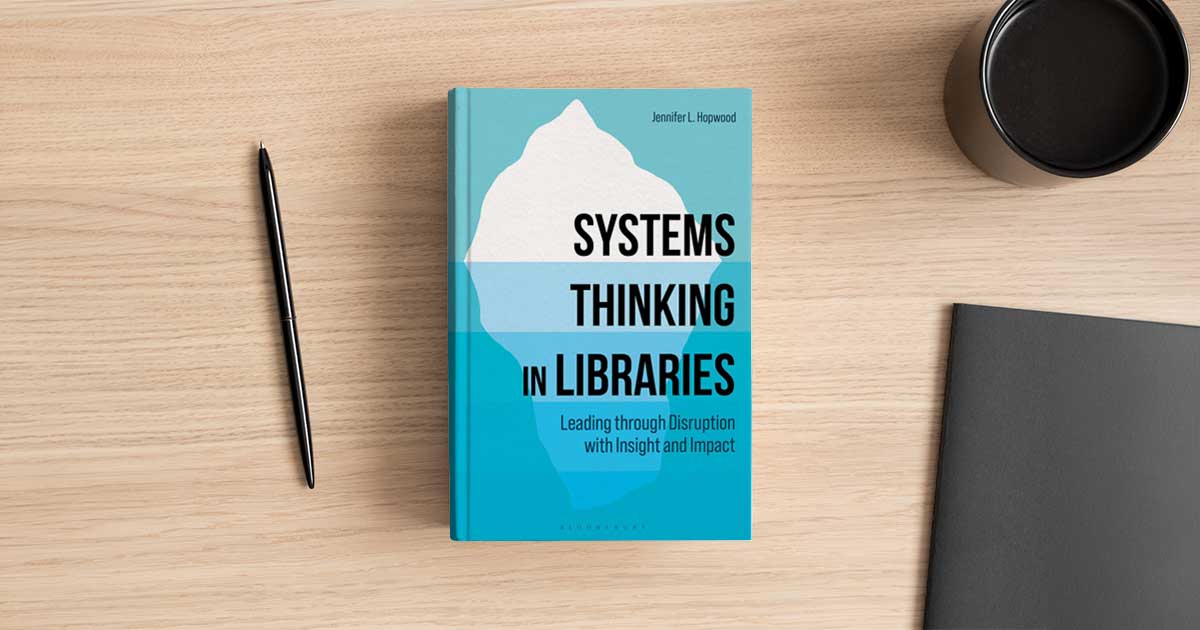
Jennifer L. Hopwood is the author of the forthcoming book Systems Thinking in Libraries: Leading Through Disruption with Insight and Impact, available for pre-order now from Bloomsbury. My interview with her is below.
Please introduce yourself to our readers.
I’m Dr. Jennifer Hopwood, and I’m a librarian, educator, author, and learning and development facilitator. I work with library staff in Southern Maryland, where much of my work focuses on staff development, organizational learning, and helping people navigate change. I also teach for San José State University’s iSchool. I like to say, “I teach library staff how to library.”
I’ve always been interested in why organizations work the way they do and why some ideas or changes take hold while others don’t. My doctoral research focused on creativity and innovation in public libraries, particularly the organizational factors that can support or inhibit creativity. That work has shaped a lot of what I do now, whether I’m designing training, thinking about organizational culture, or looking at how libraries respond to change.
Briefly summarize Systems Thinking in Libraries: Leading Through Disruption with Insight and Impact.
Systems Thinking in Libraries is really about learning to understand a problem before we rush to solve it.
Librarians are very good at problem solving. We talk a lot about things like design thinking, and those tools can be incredibly useful when we are trying to develop solutions. But sometimes developing a solution is not actually the first thing we need to do. Sometimes we need to step back and make sure we understand the problem we are trying to solve.
For example, imagine that attendance at a library program has dropped. It would be very easy to identify that as an engagement or marketing problem. Maybe we need different programs. Maybe we need to advertise them differently. But what if gas prices have gone up significantly and the people who usually attend are having trouble getting to the library? We could spend a lot of time creating better marketing for a problem that marketing cannot solve.
Systems thinking helps us slow down and look at what else might be happening. It gives us tools for identifying patterns, relationships, assumptions, feedback loops, and underlying structures so that we can get closer to understanding what is actually creating the outcome we see. The book takes those ideas and makes them practical for libraries.
Why did you decide to write this book?
Systems thinking is actually something I was introduced to fairly early in my career by a former library director. She had a business school background in addition to her library degree, so the systems thinking ideas she introduced me to were coming largely from that world. Later, when I was working on my doctorate in an education program, I encountered systems thinking again, but through a very different disciplinary lens. That was fascinating to me because I was seeing many of the same ideas approached from two different fields. It helped me realize just how broadly applicable systems thinking could be.
Maryland libraries also have a rich history of embracing systems thinking. For a long time, there were people within our library community who knew this work and carried that knowledge forward. But since the pandemic, we have lost some of that institutional knowledge. People retired, people changed positions, organizations changed, and some of those ideas stopped being part of our regular conversations. At the same time, I started noticing systems thinking showing up again outside of libraries. I was seeing a resurgence of interest in it, and I kept thinking, “Librarians need to be talking about this again.”
However, a deep dive into the information out there did not really fit the library world. The closest I got was Peter Senge’s work with schools. I even took a course through MIT that was great but so technical that I could not really recommend it for staff who did not already know about the concept. That was really the impetus for the book. I wanted to create something that could explain the concepts in a context that library staff could clearly embrace.
What do you see as the biggest issue causing disruption in libraries today?
I think the biggest challenge is that there isn’t one source of disruption. There are a lot of things happening at the same time—AI and rapidly changing technology, staffing issues, funding pressures, challenges to materials and programs, changing community expectations, and changes in the workforce itself. But what systems thinking asks us to recognize is that none of those things happens independently. They interact.
That is where I think librarians can get into trouble. We see an outcome and naturally want to do something about it. That instinct is useful—we are problem solvers. But we can very easily end up solving the wrong problem because the thing we can see is not necessarily the thing creating it. And when that happens, we can also find ourselves drifting into scope or mission creep as we keep adding solutions without addressing the underlying issue.
That is why I think systems thinking is particularly useful during disruption. It helps us resist the pressure to immediately ask, “What should we do?” and spend a little more time asking, “What is actually happening here?”
What are two things you hope all readers take away?
The first is that identifying the problem is part of problem solving. That sounds incredibly simple, but I think we skip that step more often than we realize. We see low attendance and decide we have an engagement problem. We see resistance to a new initiative and decide we have a change-management problem. We see poor communication and decide people need communication training. Sometimes those diagnoses are right. Sometimes they are not.
I want readers to become comfortable staying in that space of curiosity a little longer. What else could be contributing to this? Is this an event or part of a larger pattern? When did it start? What changed? What assumptions are we making? What might we not be seeing?
The second thing I hope readers take away is that systems thinking is something anyone can use. You do not need to be a director, administrator, or systems thinking expert. In fact, people working in different parts of a library often see different pieces of the system. Someone working directly with patrons may recognize something that is almost invisible from an administrative office. The more people throughout an organization who learn to notice patterns and ask better questions, the better our understanding of the whole system can become.
Lucidea’s audience includes special librarians and school librarians. In what ways do you see this book being beneficial for special librarians? Then, in what ways do you see this book being beneficial for school librarians?
One of the reasons I think systems thinking translates so well across different types of libraries is that every library exists within a larger system. I was very deliberate when writing the book to find examples from many different types of libraries from around the world.
For special librarians, that larger system might be a corporation, government agency, law firm, hospital, museum, or another organization. The library is one part of a much larger network of people, priorities, resources, workflows, and decisions. Systems thinking can help special librarians understand those connections and, importantly, communicate the library’s value in terms of what happens elsewhere in the organization because the library exists.
Instead of only saying, “We answered this many research requests,” you can start asking what those research requests made possible. Did someone make a better decision? Save time? Reduce risk? Complete research more efficiently? That begins to show the library as part of the organization’s larger system rather than as a separate service operating alongside it.
School librarians are also working within an incredibly complex system. They have students, teachers, administrators, families, district leadership, curriculum requirements, technology, budgets, schedules, and policies all interacting with one another. A problem that appears to be happening in the school library may actually originate somewhere else in that system. If students are not using the library, for example, it might be tempting to conclude that students are not interested in the library. But perhaps there has been a scheduling change. Maybe teachers have less flexibility to bring classes in. Maybe a policy has unintentionally made access more difficult.
As I mentioned, systems thinking helps us understand the larger picture. I was at a library conference where I had a conversation with a children’s book vendor about how school library book bans in Texas were affecting the decisions his company was making and, in turn, the services it could offer in other parts of the country. That conversation was a great example of why systems thinking matters. These are not isolated events. A decision made in one state can create ripple effects for vendors, libraries, schools, and communities across the country. Those connections may not always be immediately visible, but they are part of the larger library ecosystem.
Is there anything else you would like to share?
I think one of the most important things to understand about systems thinking is that it is not competing with all the other tools we already use in libraries.
I mentioned design thinking because libraries have really embraced it, and I think that is a good thing. Design thinking gives us some wonderful ways to approach problems and develop solutions. Systems thinking can help us make sure we are working on the right problem in the first place. Sometimes we are so eager to get to the solution that we skip over understanding what is actually happening. And solutions are satisfying. We can create a new program, change a process, develop a training, or launch a new initiative and feel like we have done something.
Understanding why something is happening can be much harder. That is the space where I think systems thinking has so much to offer libraries right now. It helps us get curious before we get busy. It helps us look beyond the most obvious explanation and ask what else might be happening in the larger system. Because sometimes we do not need a better solution. We need a better understanding of the problem.







0 Comments