

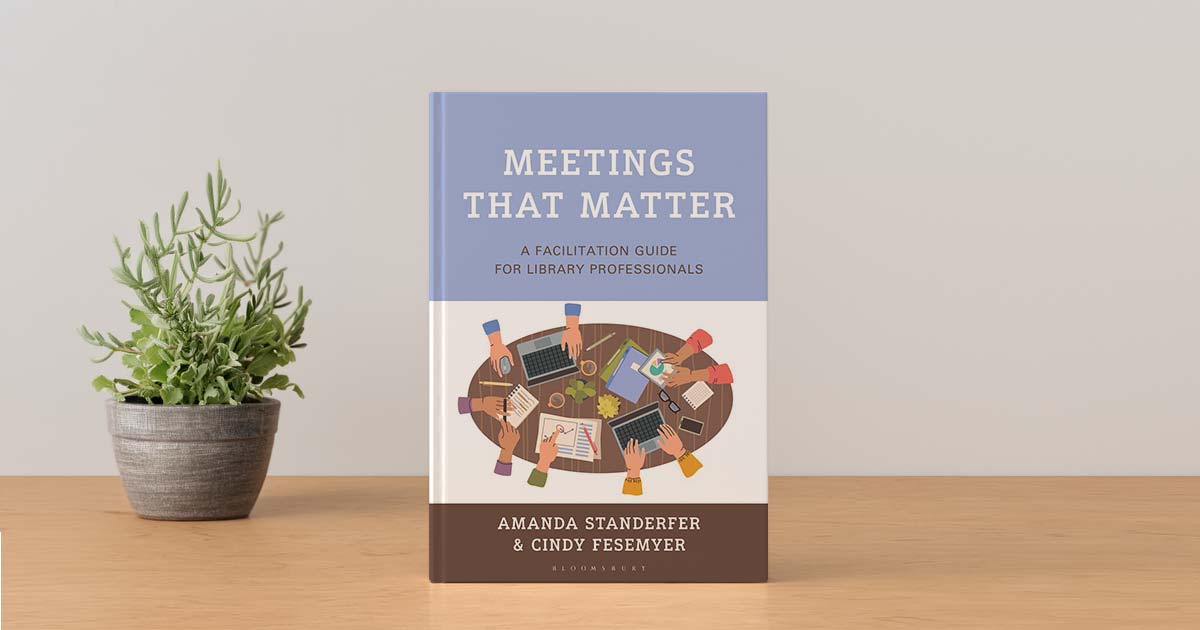
Meetings are part of all of our professional lives. In the upcoming book Meetings That Matter: A Facilitation Guide for Library Professionals, available for pre-order now, Amanda Standerfer and Cindy Fesemyer provide excellent strategies and ideas for making meetings more successful. My interview with them is below.
Please introduce yourselves to our readers.
Amanda Standerfer: Hi, I’m Amanda Standerfer. I’m a librarian and library consultant based in Chicago and Champaign, Illinois. I’ve worked in Illinois libraries for 25 years in roles ranging from children’s librarian to director, and I’ve also worked at a system level and as a trustee. Additionally, I’ve worked in the philanthropy sector for family and community foundations. For the past four years, I’ve exclusively consulted through Fast Forward Libraries and the Alliance for Library Impact.
Cindy Fesemyer: Hey, I’m Cindy Fesemyer, located in Madison, Wisconsin. We’re both Midwestern women! I’ve been doing independent consulting primarily for libraries and library support organizations full-time for about five years now. Prior to that, I was the library director in Columbus, Wisconsin—a smaller exurb community—for seven years. From there, I worked for the State Library of Wisconsin for about three years before transitioning away from the cubicle life during COVID. Like Amanda, I’ve been library staff, a trustee for my hometown library in Madison, and on the Friends of the Library board. I also taught continuing education and academic courses regularly for the UW-Madison iSchool. In addition to this book, I had another one come out earlier this year on library management for smaller and rural libraries.
Please briefly summarize Meetings That Matter: A Facilitation Guide for Library Professionals.
Amanda Standerfer: Good meetings are essential to a robust library. The workbook starts with broader concepts, such as what it takes to be a good facilitator and what to consider when organizing a meeting. It provides templates, reflection spaces, and self-assessments to help you gauge where you are on your facilitation journey.
From there, it details what to do during a meeting when you run into trouble, essential skills you might need, and tips for when a meeting feels stuck. It covers conflict management and how to ensure proper follow-up. We like to say that a majority of a good meeting is in the planning, so much of the book focuses on planning and thinking through what makes a good meeting, followed by running and following up after it.
Cindy Fesemyer: We also had a couple of guest contributors. Mia Henry kicks off the first chapter with a discussion on power dynamics within our profession and meeting rooms, helping readers assess their position in their community and organization relative to that power.
We also have contributions from Martin Alvarado, the Community Engagement Librarian for the Madison Public Library in Wisconsin. He’s a trained, seasoned facilitator like us, and as a native Spanish speaker, he has worked with very diverse groups as an interpreter and translator. He contributed thoughts on working with people who speak different languages, collaborating with translators, and navigating cultural norms across different groups. Their contributions really helped augment what we bring to the table.
Why did you decide to write this book?
Cindy Fesemyer: The fact is, we didn’t plan to; we were approached! We were giving an American Library Association pre-conference session in San Diego back in 2024. We did our usual hands-on half-day session, which mirrors the book: self-analysis, interactive activities, and walking away with a plan. Afterward, we were approached by the woman who became our editor from Bloomsbury. She felt this filled a niche in library and community facilitation that Bloomsbury wanted to explore.
Amanda and I are primarily virtual and in-person trainers rather than book writers, but I was in the middle of writing another book at the time, so I knew we could pull it off pretty easily. I’m really glad we wrote it. Both of us received facilitation training early in our careers; my background started in non-profits before transitioning to libraries in my 40s. That training made a massive difference in our ability to jump into our roles and make decisions based on community needs rather than just what the library assumed the community needed. We’re big fans of how facilitation helps libraries make a bigger impact.
Amanda Standerfer: Facilitation training helps far beyond meeting settings. It improves everyday conversations and helps you understand the flow and structure of discussions. It was an essential skill I learned early on, and I noticed a lack of library-specific facilitation training available. That need is really what grew into the pre-conference sessions we gave over the years and, ultimately, this book.
What are two main ideas you hope all readers take away?
Amanda Standerfer:
- Facilitation requires practice: You just have to practice. Even now, I still have meetings that don’t go as planned. I take time to reflect on what I could have done differently. You have to keep practicing and actively ask for feedback.
- Learn by observing others: I learned a lot by watching great facilitators, noticing their techniques, and adapting them for my own use. If you haven’t experienced great facilitation firsthand, listen to NPR interviews or watch news coverage to see how professional interviewers steer conversations and engage people.
Ultimately, both points are about building your confidence. You don’t have to be an extrovert to be a great facilitator. It’s really about understanding group dynamics, practicing, and integrating what works over time.
Cindy Fesemyer: A third takeaway is that good facilitation is rooted in being a good listener. Listening doesn’t always come naturally to people in our profession because when someone asks for help, our instinct is to jump in immediately with answers. When facilitating, you aren’t doing much of the talking; you’re using quality listening skills to keep the conversation on track.
The book is interactive. What can readers expect?
Cindy Fesemyer: It starts with Mia Henry’s chapter on setting the pace and self-analysis. There is room for introspection regarding past meeting experiences—both good and bad. We list many skill sets for facilitators and emphasize that you don’t need to master all of them; focus on what you already do well and identify areas you’d like to practice.
Another key part is guiding readers on how to build an effective agenda. In our opinion, the key to a good meeting is a good agenda. People need to see it ahead of time, know what to expect, understand time allocations, and know who is leading each section.
We also share strategies for approaching different meeting formats—in-person, virtual, co-worker, community, or one-on-one—and how to prepare for those conversations. Finally, Amanda covers how to navigate difficult meeting situations. While people often fear worst-case scenarios, most meetings go fine, but we provide practical strategies just in case.
What are your suggestions for how readers should interact with the book?
Amanda Standerfer: You don’t need to read it straight through; feel free to skip around to the sections you need most. Take the self-analysis sections seriously to determine your strengths and areas for growth. Discussing these reflections with a peer or mentor can also be very helpful. Lean into your existing strengths, get feedback on areas where you feel less comfortable, and prepare as best as you can.
Cindy Fesemyer: Be mindful when attending meetings facilitated by others. Pay attention to what works, note what you would have done differently, and store those insights away for your own practice. When I facilitate community conversations across the country, participants often remark on the facilitation process itself—which tells me they are mindful of how meetings are structured. Being observant in everyday meetings will go a long way in strengthening your own skill set.
Amanda Standerfer: Don’t view us as the sole experts on this topic. Bring your own experiences to the table and build on what we’ve provided to make the approach your own.
Is there anything else you would like to add?
Cindy Fesemyer: The book comes out in January 2027. We love hearing from people, so please feel free to reach out to us with questions or to share your experiences!
Cindy can be reached at: fesemyerconsulting@gmail.com
Amanda can be reached at: amanda@standerferconsulting.com
Amanda Standerfer: We also offer customized facilitation training for library systems, whether a library is struggling with internal communication or looking to refresh stale meetings. Reading the book is a great first step, but practicing in a controlled training environment helps bring those skills to life.



0 Comments