

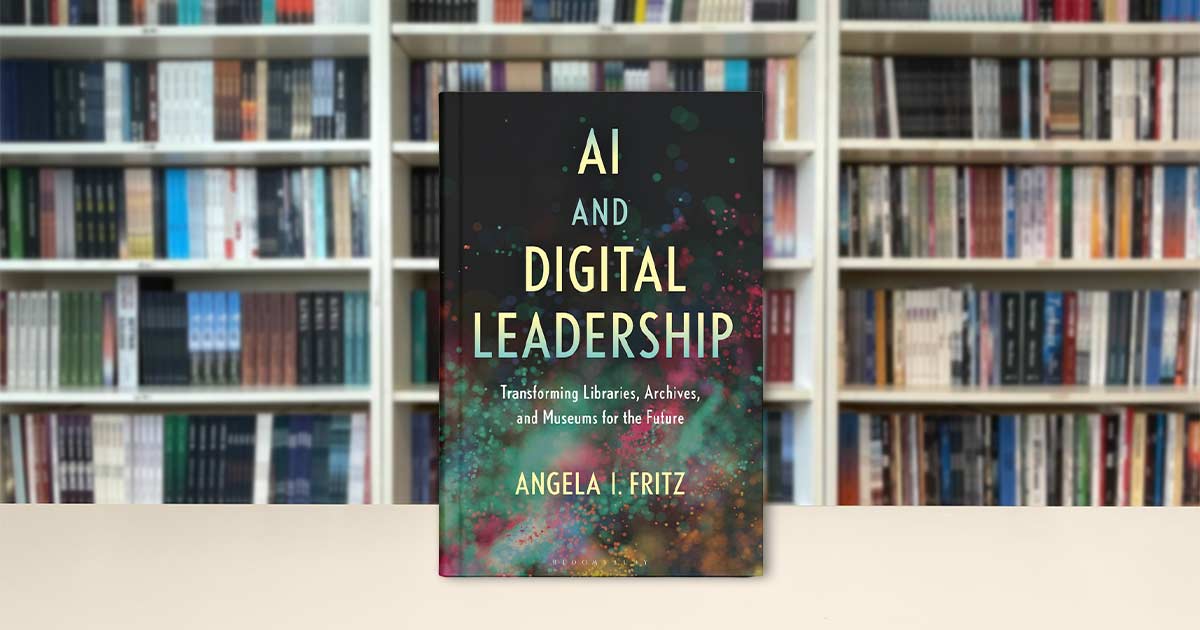
Angela Fritz is an assistant professor at the University of Iowa and the author of AI and Digital Leadership: Transforming Libraries, Archives, and Museums for the Future, available from Bloomsbury.
In our conversation below, Fritz discusses why AI demands a leadership model grounded in collection care, how practitioners can build AI literacy, and what inclusive, care-centered leadership looks like in day-to-day GLAM work.
Please introduce yourself to our readers.
My name is Angela Fritz and I am an assistant professor at the School of Library and Information Science (SLIS) at the University of Iowa. I teach classes on archives and digital preservation in support of SLIS’s Special Collections and Archives Certificate program. I’ve held leadership positions at the Wisconsin Historical Society, the University of Notre Dame, and the Office of Presidential Libraries and Museums at NARA.
I have a deep interest in GLAM digital convergence and integrated collection management, which was the subject of my first book, Sustainable Enterprise Strategies for Optimizing Digital Stewardship: A Guide for Libraries, Archives, and Museums.
My current research explores the multifaceted concept of ethical AI with a specific focus on emerging frameworks that balance an ethics of care with AI-enhanced stewardship practices across the GLAM sector.
Briefly summarize AI and Digital Leadership: Transforming Libraries, Archives, and Museums for the Future.
My book explores the need for a new leadership framework that prioritizes an ethics of collection care as libraries, archives, and museums transition to AI-integrated work environments. My book makes the case that GLAM leadership in the age of AI is more than just integrating emerging technologies for added efficiencies and innovation. Rather, digital leadership is just as much about the ability to use soft skills to recast professional ethics and shared values in new contexts.
Why did you decide to write this book?
My book draws from over a decade of experience in leadership positions in the GLAM sector. During this time, I was consistently amazed at the persistent disconnect between digital practitioners, who steward collections, and GLAM administrators, who advocate for the resources necessary to sustain digital stewardship programs.
This experience led me to grapple with a range of questions: What accounts for this disconnect? How do we situate stewardship accountabilities beyond digital practitioners? How might AI transform digital stewardship in GLAMs and what skills will be needed to lead this transformation? This book is the result of thinking about these questions and presenting some possibilities and new considerations for effective leadership in the GLAM sector.
Will you share a couple of examples of how AI is impacting the work of libraries, archives, and museums?
It’s important to understand that AI is not new to GLAM. Libraries, archives, and museums have a rich history of experimenting with AI and machine learning. However, this moment in time is very different. The current landscape is marked by the rapid development of commercial AI products. Currently, most GLAM practitioners are encountering embedded language models in the proprietary platforms that they use on a daily basis. This is why AI literacy initiatives are critical for practitioners. Such training equips librarians, archivists, and museum curators with the foundational knowledge needed to evaluate commercial AI products and ensure alignment with responsible stewardship practices.
In addition, GLAM institutions are engaging in a significant amount of research and development on open-source language models and tools to aid with specific stewardship tasks. These tools are in early development but will eventually help practitioners in many functional areas of their work, particularly in managing complex born-digital collections.
Why does generative AI impact the type of leadership models that staff in libraries, archives, and museums should use?
One of the defining characteristics of digital leaders is the ability to guide GLAM organizations through successive waves of technological change. For example, over the past few years, GLAMs have been navigating the rapid development of generative AI. The next wave of AI development may very well usher in a host of agentic AI products that will enhance teamwork and project management.
Digital leaders need to help practitioners navigate these waves of continuous change by empowering them to assess the value of these new tools, align these tools with responsible stewardship practices, assess the outcomes, and then realign with the next stage of AI enhancements. Increasingly, digital leaders will need to help their institutions manage iterative cycles of digital transformation but in a way that enhances responsible stewardship practices that are already in place.
What are the two things that you hope readers will take away?
One of the most significant insights that I have gained from teaching is heightened awareness and sensitivity to the level of AI anxiety that many students and practitioners are experiencing. This anxiety seems to stem from a wide range of unknown implications and impacts resulting from the accelerated commercial development of AI.
As we manage a new pace of change in the workplace, I hope that the readers of my book will feel empowered to advocate for leadership models at their institutions that prioritize wellbeing, care for staff, and the importance of elevating the specialized skills that practitioners bring to their work.
The second takeaway relates to the hope that GLAM practitioners recognize that they have an incredible amount of agency at this moment in time to shape and define how AI is integrated into their work.
Our profession has a long history of adapting innovative, people-centered uses of emerging technologies. GLAM practitioners’ expertise and tradition of care-based practices will be essential in facilitating human connection with the communities that they serve, which will be as important as ever in making meaningful and impactful uses of AI in GLAM settings.
Is there anything else you would like to share?
I would encourage the GLAM field to embrace more inclusive definitions of leadership at their institutions. Leadership happens in multiple ways by multiple people across any organization. The value in this begins by acknowledging and nurturing opportunities for people to embrace their own leadership potential. When we do this, our institutions become stronger.
This can happen by supporting seasoned professionals in enhancing their experience with new AI skills, investing in in-house communities of practice for AI innovation, supporting inclusive teams of practitioners in AI assessment and audit practices, and nurturing emerging professionals and students who may become next-generation digital leaders.







0 Comments