
Lucidea’s Lens: Knowledge Management Thought Leaders Part 62 – Max Boisot

Stan Garfield

Max Boisot was a British architect and management consultant who was professor of Strategic Management at the ESADE business school in Barcelona. Max was known for his ideas about the information economy, the Information Space, social capital, and social learning theory.
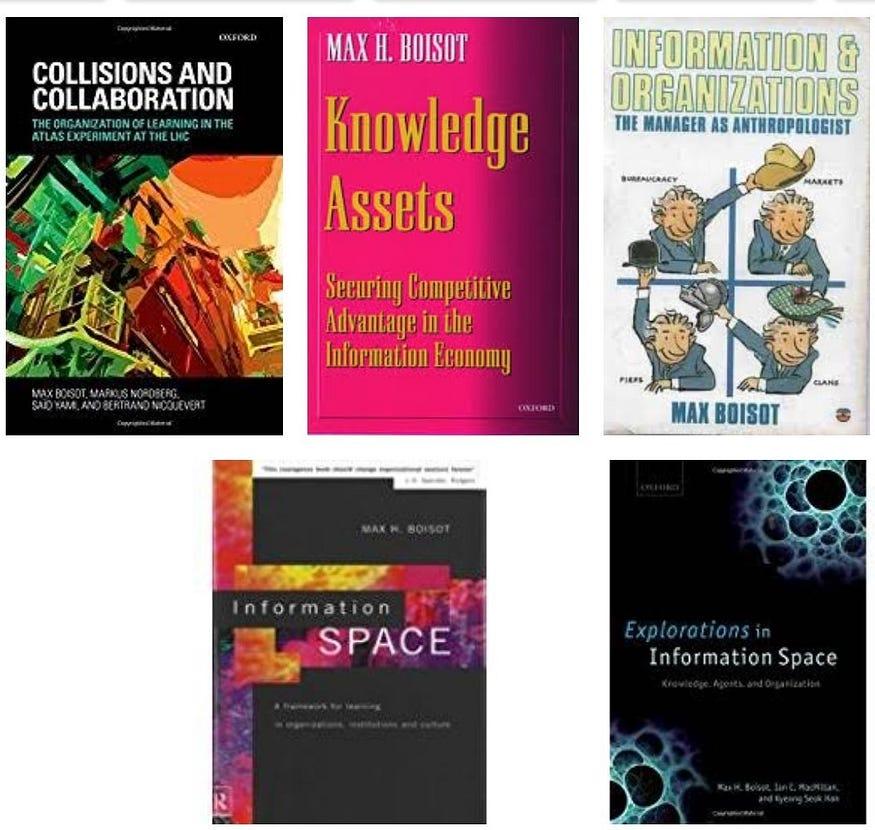
Books
The I-Space: a framework for analyzing the evolution of social computing with Benita Cox
Abstract
Advances in the design of computer architectures and networks have led to new ways of representing, creating, manipulating and distributing knowledge. This paper takes a sociotechnical view of computing and considers the impact of computer architectures which are based on connectionist principles and the growth in computer networks on the representation of the learning process and strategies for dealing with complexity. It calls for a new economic view of knowledge and intellectual property rights more appropriate for the analysis of information flows in networks. Finally, the Information Space (I-Space) is presented as a framework for the analysis and evaluation of information flows.
Section snippets
A theory of information flows
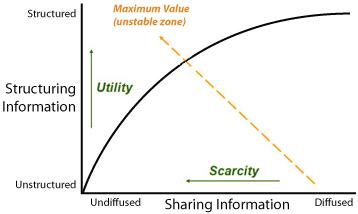
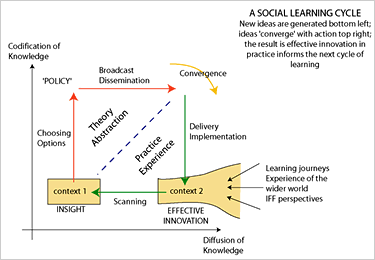
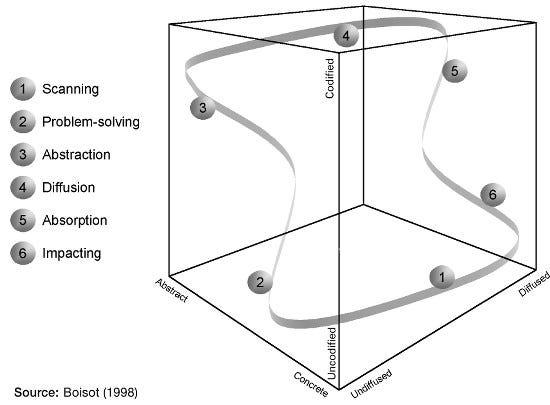
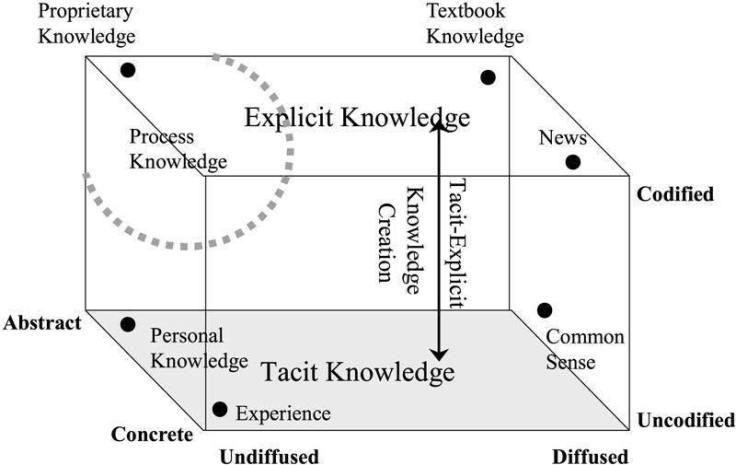
The Information Space, or I-Space, is a conceptual model that relates data structuring to data sharing among a population of data processors. It has to date only been applied in situations where data processing agents have been individual human beings or organizations and institutions made up of these.
Institutional mappings
If we equate serial and connectionist architectures with transactional structures, where might we locate them in the I-Space? One feature that distinguishes serial and connectionist processes is the extent to which computational activity is under central control. It can be argued that serial processes require central coordination and are therefore likely to be located to the left along the diffusion dimension of the I-Space. Connectionist processes, by contrast, can be decentralized.
The microelectronic revolution in the I-Space
To be viable, a political economy of information requires an integrated theory of information production and exchange. Serial and connectionist models of computation might plausibly be viewed as alternative accounts of information production and exchange. The I-Space provides a conceptual framework that brings them together in a single unified representation and hence contributes to the kind of theory building that is needed.
Conclusions
What are the implications of the foregoing for the emerging disciplines of knowledge management? Knowledge is not data, nor is it information. It is a dispositional state that is modified by the receipt of information. In the language of neural networks, it is a given node’s predisposition to fire. New information, by modifying connection strengths, modifies that predisposition. Information, however, has to be extracted from data.
Images
Stan Garfield
Enjoy Stan’s blog posts offering advice and insights drawn from many years as a KM practitioner. You may also want to download a free copy of his latest book for Lucidea Press: Knowledge Nuggets: 100 KM Infographics. Learn about Lucidea’s Presto, SydneyEnterprise, and GeniePlus software with unrivaled KM capabilities that enable successful knowledge curation and sharing.
Never miss another post. Subscribe today!
Similar Posts

The LEXICON Framework Part 4: Integrate with Existing Systems
Stan Garfield explores practical ways to embed KM tools into the platforms your team already uses reduces friction, boosts adoption, and makes organizational knowledge easier to access.

The LEXICON Framework Part 3: 10 Ways to eXplain the Value of Knowledge Management
KM expert Stan Garfield offers 10 practical ways to explain and prove the value of knowledge management using Clare Bilobrk’s LEXICON framework.

The LEXICON Framework Part 2: Empower Champions of KM
In part two of our LEXICON series, we explore how empowering KM champions can strengthen knowledge management adoption. Discover practical strategies to identify champions, define their roles, and connect them across your organization.

The LEXICON Framework Part 1: Link KM to Daily Workflows
Stan Garfield explores the LEXICON framework for KM, sharing 16 strategies to embed knowledge management into daily workflows effectively.
Leave a Comment
Comments are reviewed and must adhere to our comments policy.
0 Comments