


Many traditional museum donation pages naturally focus on broad operational needs, often inviting supporters to contribute directly to a general Annual Fund. While these foundational gifts remain vital for sustaining daily operations and keeping the lights on, abstract fundraising can sometimes miss an opportunity to connect with today’s digital donors. Modern supporters increasingly look for immediate transparency and a highly visible, personal connection to specific initiatives or objects. Ultimately, they want to see the direct impact their financial gift makes.
To bridge this gap, innovative development teams are connecting their fundraising software directly to their museum Collections Management System (CMS) and online public portal. By turning a static inventory catalog into an interactive Adopt-an-Artifact platform, museums are revolutionizing patronage—driving direct financial aid, micro-memberships, and community investment—one object at a time.
Personalizing Philanthropy through Tailored Giving Options
The core psychological engine behind a successful adoption program is hyper-personalization. Instead of donating to a massive, faceless institution, a patron is giving directly to a piece of history that resonates with their own life story, hobbies, or ancestry.
Through the CMS, curators can assign an Adoption Status (e.g., Available, Adopted, Needs Conservation) and a specific Adoption Tier ($25, $100, $500, $1,000, etc.) to thousands of items across the collection.
When a user browses the public collections portal and encounters an object they love—whether a 19th-century wedding gown, a fossilized dinosaur tooth, or a vintage local transit map—they are met with a prominent, integrated “Adopt this Item” button.
This micro-donation structure turns casual web browsing into a gamified, emotionally resonant giving experience. Common micro-giving personas are:
- The Educator: A local teacher might adopt a historical textbook or support educational assets.
- The Enthusiast: A car lover funds the high-resolution digitization of a vintage blueprint and related archives.
- The Stakeholder: Casual visitors instantly become financial investors because they chose exactly where their money went.
By tapping into each of these potential micro-investors, the museum builds an immediate emotional bridge between its assets and its audience. This targeted alignment transforms casual digital discovery into a profoundly personal act of preservation, ensuring every donor feels like a true steward of history and culture.
Hardcoding Recognition: The Digital Credit Line
The true magic of a CMS-driven adoption program lies in how it delivers instant gratification and public validation to the donor. The moment the adoption transaction clears via the online portal, the web system communicates directly with the staff, entering a workflow to update the backend database.
As part of the digital flow, the adoption process will capture the adopter’s name—facilitating an update to the object record to include a credit line reflecting the sponsorship of the item. Updates to the public portal are automatic and display a personalized recognition tag. For example: “Digitally adopted by [Donor Name] in honor of [Loved One] for the year 2026.”
This digital plaque gives the donor a proud sense of stewardship and a permanent link to share with their social networks. By using the system to hardcode recognition into the collection’s public infrastructure, you create a deeply satisfying feedback loop that encourages repeat giving, birthday gift adoptions, and multi-year renewals.
Museum Spotlight: The Heckscher Museum of Art (Powered by Argus CMS)
A beautiful example of this model in action is The Heckscher Museum of Art‘s Adopt-a-Work-of-Art program. The museum invites patrons to directly look through their collections online and choose a specific artwork to sponsor.
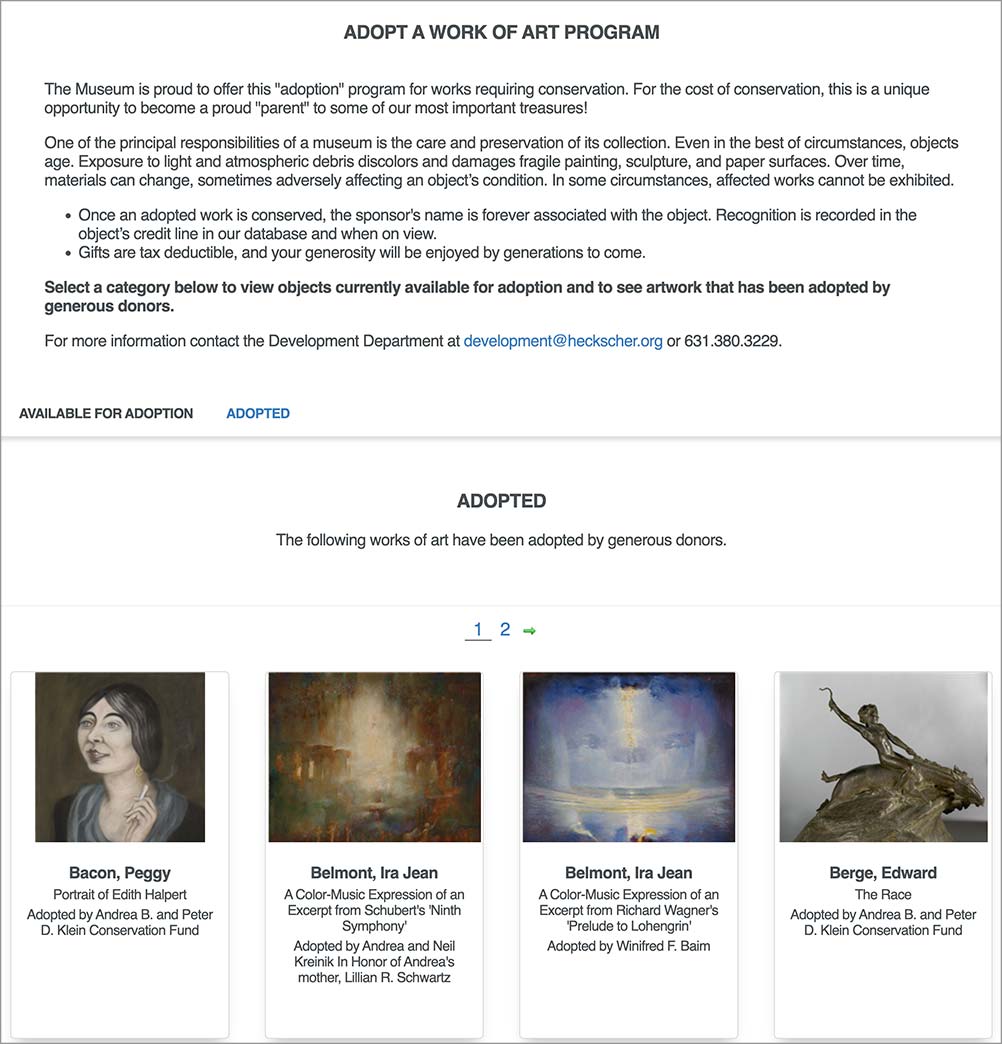
“Adopt a Work of Art Program,” The Heckscher Museum, accessed July 1, 2026.
The funds raised from these adoptions go directly toward the vital care, conservation, and framing of the chosen pieces, as well as supporting their display in upcoming exhibitions. By linking philanthropy directly to individual collection items, the museum gives donors a transparent look at exactly how their gifts safeguard local cultural heritage. This transforms a standard donation into a tangible act of preservation.
Creating a Frictionless Pipeline for Annual Memberships
An “Adopt-an-Artifact” portal serves as the perfect low-barrier gateway to long-term membership programs. The data collected during a micro-donation adoption can seamlessly tap into a digital workflow with data for both your CMS and Customer Relationship Management (CRM) system. And cultivation can continue from there.
For instance, if a donor adopts a piece of mid-century modern furniture, the system flags their specific affinity for design. The museum can then send targeted updates, such as:
“Thank you for adopting our Eames chair! Because you love design, we think you’d enjoy our upcoming gallery talk. Click here to upgrade your adoption into a full annual membership for just $35 more.”
By using the CMS to initiate highly targeted, object-specific conversations, you dismantle the friction of traditional fundraising and build a highly responsive pipeline of lifetime supporters.
Your Most Underutilized Storefront
Unlock your museum’s most underutilized storefront: the collections portal. By adding direct adoption capabilities to your database and online portal, you can turn a standard digital catalog into a powerful fundraising engine. Tiny, personal digital interactions can inspire major philanthropic support and build lifelong patronage.
Frequently Asked Questions
What is an adopt-an-artifact program?
An adopt-an-artifact (or adopt-a-work) program lets supporters sponsor a specific object in a museum’s collection through its online portal. Each adoption funds the care, conservation, or digitization of that item, giving donors a direct, personal connection to what they support.
How does a museum CMS support artifact adoption?
A CMS can flag each object with an adoption status and giving tier, display an “Adopt this Item” button on the public portal, and automatically record the donor’s name as a credit line. Connecting the CMS to e-commerce and CRM systems turns a browse into a tracked donation.
Can artifact adoption lead to museum memberships?
Yes. Because each adoption reveals a donor’s specific interest, museums can follow up with targeted invitations to upgrade to annual membership, making adoption a low-barrier gateway to long-term support.



0 Comments