


This is the eighth in the series offering advice on the practice of knowledge management. Throughout my career in KM, I have enjoyed serving as a mentor to others in the discipline. In this series of posts, I answer questions posed to me as a mentor. If you would like to submit questions for me to answer in this series, please send them to stangarfield@gmail.com.
What are your thoughts on Zach Wahl’s annual KM trends blog post for 2026?
Answer: Since 2019, Zach Wahl has published his annual blog post on the biggest knowledge management trends for the year. In my thought leader profile of Zach, I featured the 2025 edition of his Top KM Trends post. Below are highlights of Zach’s latest eight trends from Top Knowledge Management Trends – 2026, with my comments added under each.
1. Knowledge Management and Semantic Layers Partnering to Power Enterprise AI
- Organizations are actively recognizing the key roles KM can play to fill knowledge gaps, support iterative improvement, and automate knowledge capture.
- KM and semantic professionals should increasingly be found at the center of an organization’s AI initiatives, ensuring business context, high-value AI-ready knowledge assets, filling knowledge gaps, and acting on hallucinations.
My comment: The rise of AI provides an unprecedented opportunity for KM to emerge from the background to play a key role in all organizations. AI should either be an integral part of a KM program, or at the very least, closely aligned with it. KM organizations should add AI specialists and train existing team members in key disciplines, including knowledge graphs, semantic layers, and GenAI models.
2. Boxed AI vs. Built AI
- For many organizations, the apparent ease and speed of implementation are too tempting to reject, and they’ve quickly jumped on the black-box AI solution.
- This year will continue to see organizations struggle between that which is easy, and that which will deliver real business value for their organization.
My comment: KM teams have long had to deal with buy vs. build tradeoffs between ease of implementation and customized functionality. This applied to repositories, enterprise search, portals, community platforms, and other KM software. AI tools now present that same dilemma. Zach cautions against grabbing an off-the-shelf AI solution and suggests strongly considering a custom approach that retains the ability to deliver more advanced reasoning and explainability.
3. Scaling AI-Ready Content and Data
- Many organizations were unwilling or unable to invest the necessary resources to ensure their knowledge assets were free of duplicated, near-duplicate, old, and obsolete content, and likewise possess the necessary metadata to add context, and power findability and discoverability.
- AI is now part of the solution. When leveraged properly, with the right foundations, it can automatically standardize and enhance knowledge assets at scale, doing the job in minutes rather than thousands of hours.
My comment: I previously offered 36 Examples of How AI Can Support KM Processes. Zach provides another important use case for AI performing a valuable function. KM programs need to take advantage of the power of AI to provide a boost to many of the tasks that were previously done manually or not at all. AI is not just a supercharged search engine – it should be used as a helpful partner.
4. Enterprise-Level Tacit Knowledge Capture
- The swift advancement of AI note-taking tools, automated transcription services, and digital meetings has quickly delivered the building blocks of an enterprise-level tacit knowledge program.
- KM professionals should lean into these capabilities, offering their expertise to guide how to craft the dialogues, pinpoint expertise, and validate outputs, while letting the automation do the brunt of the work.
My comment: These capabilities can be helpful, but tacit knowledge capture is an elusive goal. I believe in getting knowledge flowing between people using communities, with AI in a supporting role. Here are ten ways AI can support communities:
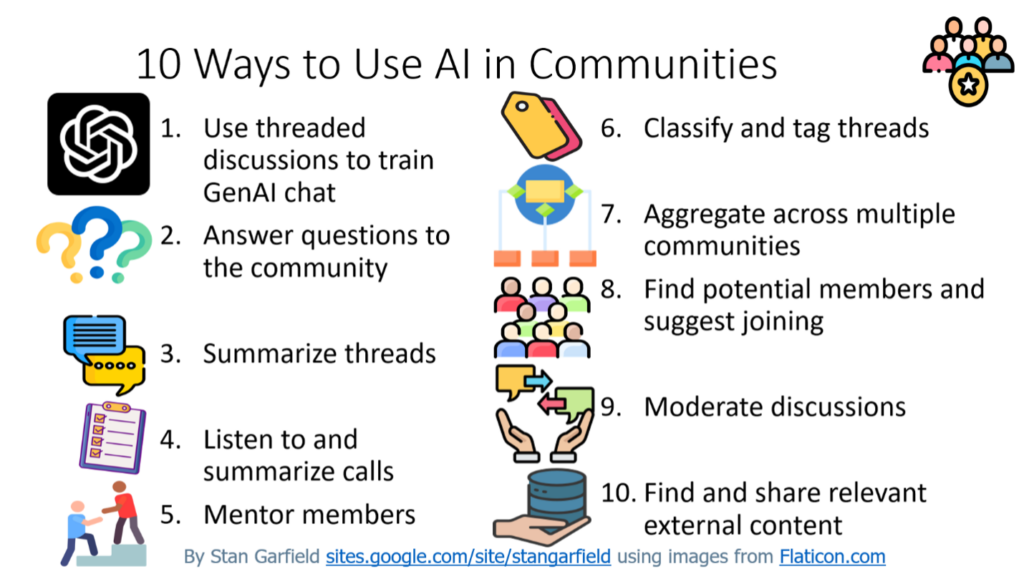
- Use threaded discussions to train GenAI chat
- Answer questions to the community
- Summarize threads
- Listen to and summarize calls
- Mentor members
- Classify and tag threads
- Aggregate across multiple communities
- Find potential members and suggest joining
- Moderate discussions
- Find and share relevant external content
5. Shifting from Enterprise Search to Conversational AI
- With the advent of AI summarization, knowledge graphs, and semantic layers, the new goal is conversational chat-style results, combined from an array of knowledge assets and delivered as an integrated answer to a question.
- ChatGPT, Gemini, and Claude are all now training end users to ask plain language questions and receive plain language results so the new standard for information seeking and delivery is conversational AI.
My comment: KM teams are used to being asked why enterprise search can’t be just like Google. Now they are faced with similar questions about why enterprise search or whatever internal AI solution is offered can’t be more like ChatGPT, Gemini, or Claude. There are similar limitations of enterprise solutions as compared to external tools, but the closer the internal AI technology can get, the better.
6. “Flattening” of Knowledge Generation and Sharing
- The most mature organizations are now leveraging semantics and AI to allow executives and stakeholders to get key business insights automatically and upon request.
- For KM professionals, there’s a great opportunity to help identify the human knowledge that is now at risk of being left out of business decisions and ensure this knowledge is injected into the organization’s semantic layer and AI solutions.
My comment: This is important, but it is easier said than done. Figuring out how to inject human knowledge into AI will take time. Initially, it makes sense to provide a summary created by a human analyst to accompany all AI-generated reports. Over time, this can be integrated into what AI provides.
7. The World of Data Adopting KM Principles
- We’re now talking in terms of knowledge assets, collectively encompassing structured and unstructured information, as well as other containers of information, including people, equipment, facilities, and processes.
- Considering metadata, governance, quality, and connectivity holistically for all types of knowledge assets will lower administrative burden and complexity, while bridging the collective knowledge of an organization and revamping operating models to power enterprise AI.
My comment: This is a positive trend, allowing a wider range of assets to be included in enterprise AI. The same caveat I made in point 4 applies to treating people as knowledge assets. The knowledge that resides in people’s heads is challenging to inventory. An inventory of communities is one way of describing where tacit knowledge exists and can be tapped.
8. Organizational Change Due to Enterprise AI
- We’re also beginning to see new AI Governance and Enhancements departments, dedicated to ensuring the accuracy, ethics, and trustworthiness of all AI operations.
- The KM professionals of today, if they’ve shown their value to the endeavors and made their case clearly, will hold key roles in this new department.
My comment: KM and AI should be symbiotic. Historically, there have been attempts to combine KM with Learning & Development, Content Management, Customer Support, Business Intelligence, and other related functions, with questionable results. This combination appears to be more natural and essential. If AI and KM are not combined, they should work together as closely as possible.
Summary
The field of knowledge management is changing rapidly, colliding in many ways with the fields of data and content management, semantics, and AI. Though some in the field will push against this, the reality is observable at this point and should be seen as an opportunity for thoughtful practitioners who can help to inject the best that KM has to offer into the highest priority AI initiatives of their organization.
My comment: I agree with Zach. This is a time of great opportunity for KM. Those who seize it successfully will prosper, while those who don’t may be left behind.
For more of Zach Wahl’s thinking, see:
- 9th Annual Midwest KM Symposium: Zach Wahl
- Making Knowledge Management Clickable: Knowledge Management Systems Strategy, Design, and Implementation by Joseph Hilger and Zachary Wahl
- Bridging Knowledge, Data, and AI: Harnessing the Semantic Layer Framework to Drive Intelligence by Joseph Hilger, Lulit Tesfaye, and Zachary Wahl








0 Comments