

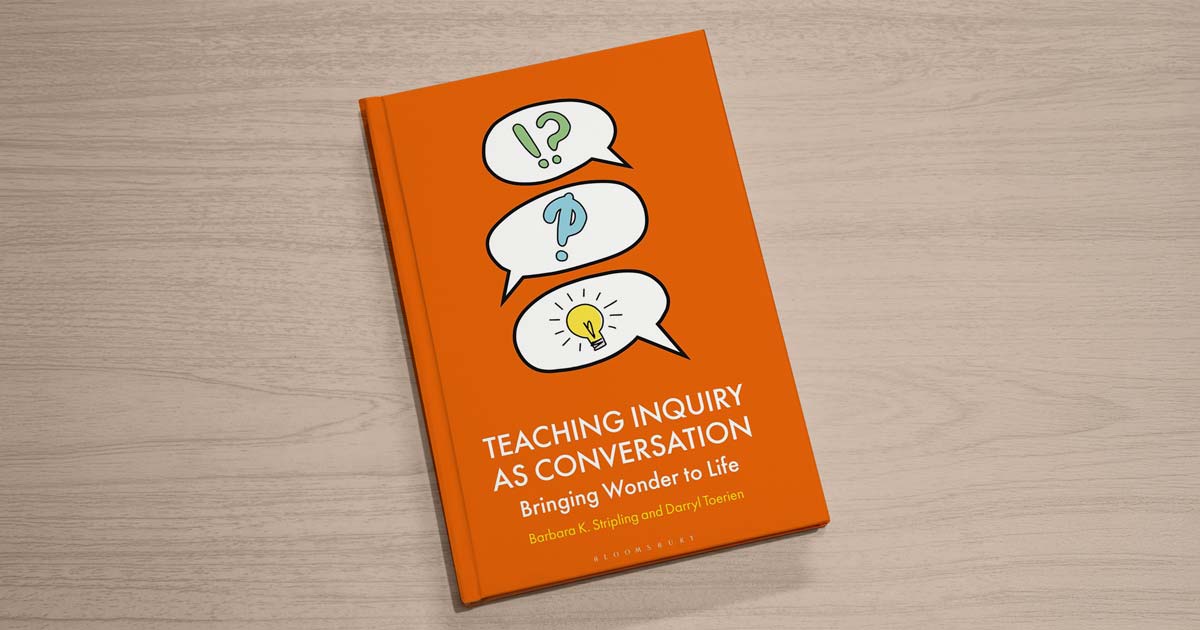
I had the privilege of speaking with Barb Stripling and Darryl Toerien, the authors of the book Teaching Inquiry as Conversation: Bringing Wonder to Life. My interview with them is below.
Please introduce yourselves to our readers.
Barb Stripling: Hello, I’m Barbara Stripling. I’ve had a long career in school libraries. I started as a practicing librarian in Fayetteville, Arkansas, for about 20 years. All but one year of that time was spent working in high schools.
After that, I became a grant administrator in Chattanooga, Tennessee, before eventually returning to Arkansas to supervise the school library program for Fayetteville. I then moved from Arkansas to New York City, where I directed the entire system of New York City public school libraries. From there, I became a professor at Syracuse University, and I am now, quote-unquote, retired.
Darryl Toerien: My name is Darryl Toerien. I’ve been the head of inquiry-based learning at Blanchelande College, which is a PK-12 school on Guernsey in the Channel Islands, since 2001. I have been a school librarian since 2003, which turns out to be the exact year Barb published her model of the inquiry process.
I developed the Framework of Skills for Inquiry Learning “FOSIL” from Barb’s model, which eventually grew into the Empire State Information Fluency Continuum in 2010. Then in 2019, I founded the FOSIL Group to support colleagues both in the UK and around the world who were interested in my work, and through extension, Barb’s work. At the moment, Barb, myself, and some other close colleagues are working to establish the Institute for the Advancement of Inquiry.
Briefly summarize Teaching Inquiry as Conversation: Bringing Wonder to Life.
Barb Stripling: For us, the book was based on our real passion for the topic and the Zoom conversations we shared over the past five years. It is an invitation to practicing librarians, classroom educators, administrators, and library educators to embed inquiry into the teaching and learning of PK through 12 schools.
We want to embed it in a way that brings a stance of wonder to the whole school and creates a pervasive culture of inquiry. Through this, students learn a clear inquiry and learning process. They learn to make meaning of what they are reading, what they are thinking themselves, what others are saying, and the world at large. That is really the baseline for the whole inquiry process and the book: empowering students to bring wonder to life. We want them to become independent thinkers and learners who are able to discover who they are and what they’re interested in. The book features a lot of practical strategies, but it also establishes the fundamental concepts that underlie real inquiry and details how to build that culture across a school.
Why did you decide to write this book?
Barb Stripling: Well, my main reason is that I have a lifelong passion for ensuring that students and learning are the absolute heart of the library program. I am not concerned about everything else that evolves from a library program if we aren’t focused on the students first; if we lose that focus, then I don’t think we are doing what we must do for our kids.
The idea of bringing wonder to life has been in my head for my entire career. I wanted to empower librarians to make that a core part of their daily practice. I don’t want “make and take” type token library programs. I want programs that genuinely empower kids. I know that as a field we have an incredibly important role to play, and I wanted to lift up the profession. I want to get us thinking about these substantive issues so we can truly change our field, rather than relying on quick fixes to develop programs that build lifelong learners.
Darryl Toerien: I initially came at the book from a slightly different starting point than Barb. More than 50 years ago, Neil Postman and Charles Weingartner pointed out that of all the survival strategies education had to offer, none was more potent or in need of explication than the inquiry environment.
Unfortunately, that still seems to be the case today on both counts. Recovering the true potency of inquiry within a school learning environment is one of the most important issues our book addresses.
What are two things you hope all readers take away from the book?
Barb Stripling: To be very brief, the first is that we can teach inquiry through conversation. It doesn’t have to be treated as some isolated unit hidden away in a corner that you only pull out if you happen to have an extra two weeks somewhere in the school year. Inquiry happens through daily conversations—conversations that students conduct with themselves, with others, with text, and with the world. It is fundamentally how we communicate and how we learn; it doesn’t need to be treated as an odd thing off to the side.
The second thing I want to communicate is that we need to take a “whole child” approach to inquiry. We aren’t just working to develop academic skills, which are obviously essential, but also the personal and social skills that enable students to grow. It helps them figure out who they are, what they want to be, how to listen to what others are saying, and how to develop deep empathy. It gives them the ability to genuinely contribute, find their own voice, and map out what they want to do. That whole-child facet is a major pillar of the book.
Darryl Toerien: I hope people realize that inquiry is fundamentally how we come to know and understand the world, as well as ourselves within it. It’s how we learn about reality.
In a school environment, that process functions as both a learning process and a teaching process directed toward the acquisition of subject knowledge and understanding. Inquiry is not something that happens in addition to what happens in the classroom, nor is it something we only do as a reward when we’ve finished all the “important” stuff. It is a fundamental way of approaching subject content. If done properly, it is an incredibly powerful vehicle for acquiring deep subject knowledge and deep understanding.
In what ways can school librarians and classroom teachers collaborate to teach inquiry as conversation?
Barb Stripling: We present a lot of different ways to collaborate because we know collaboration is essential to this work. There’s no point in having a library that is entirely separated from the lifeblood of the school.
However, true collaboration is not something you simply schedule for Friday at 2:00 PM. It is a continuous, fluid process. It’s important for librarians, classroom educators, and administrators to be part of a school-wide conversation where they understand each other’s priorities. From there, you figure out what you can do to enhance and strengthen those priorities to enable everyone to be successful—the students, the teachers, and the administrators alike.
For example, we talk about looking directly at the priorities of the building principal. If the principal’s top priority is literacy, the connection between literacy and inquiry is completely unbreakable; they are highly complementary, overlapping concepts. By helping the administrator see that their goals are essentially the priority of the library program, we can seamlessly collaborate with classroom teachers to bring that vision to fruition.
Furthermore, collaboration itself needs to be explicitly taught to students. We often put kids into groups, but we rarely teach them how to collaborate. We need to teach them how to share airtime, how to learn from peers, how to push back respectfully when they disagree, and how to comfortably change their minds when presented with new evidence. It’s a multifaceted collaborative environment, and that is what brings inquiry into the daily life of a school.
Darryl Toerien: Something I have found particularly helpful throughout my career is an insight from Douglas Knight, who noted that all librarians are teachers whose specialist subject is the inquiry process of learning itself. That is the unique perspective and expertise we bring to the table.
Moreover, school librarians possess a specialist interest in how that inquiry process unfolds across all other academic disciplines. Our collection development, then, is informed by a deep understanding that these various branches of knowledge cohere into a meaningful whole. This, in turn, equips us with a vital interdisciplinary perspective in terms of targeted resources that support learning in and between disciplines. A truly powerful point of collaboration maps directly to that dual specialty of process expertise and resource curation.
With the rapid acceleration of AI, I feel that cultivating a sense of wonder is something we all need right now. How do you see this conversation fitting into our current times?
Barb Stripling: I personally believe that AI has made the role of the school librarian ever more essential to the learning process. The PK-12 school ecosystem is the last chance we have to equip every growing citizen with vital evaluation skills and an expectation for critical thinking.
Moving forward, our job is to help teachers, students, and ourselves figure out how to navigate and use AI successfully. We must figure out how to maintain high-level thinking while taking advantage of the unique opportunities offered by AI. It shouldn’t be viewed as a replacement for thinking, but rather as a tool to step up the level of cognitive processing individuals do with information.
Darryl Toerien: I think one of the most far-reaching contributions of our book is the formal definition of inquiry that Barb and I formulated between late 2020 and early 2021.
We defined inquiry as a stance of wonder and puzzlement that gives rise to a dynamic process of coming to know and understand the world and ourselves in it, forming the basis for responsible participation in community. This process is inherently communal because coming to know and understand always involves other people. It involves the living people we are fortunate enough to be in face-to-face relationships with, as well as the thinkers who have gone before us or are far away, whose written words we enter into conversation with.
This communal dimension of coming to know and understand is exactly what makes us distinctly human. Somewhat paradoxically, the acceleration of AI is going to bring into much sharper focus what it truly means for us to be human, and crucially, what constitutes a fully human education. Our book makes an important contribution to that exact topic, and it serves as an open invitation to join that conversation.
Is there anything else you would like to share?
Barb Stripling: I would just like to reiterate that our biggest hope is that we are starting an ongoing dialogue. The book is an open invitation for readers to engage in a continuous conversation. Darryl and I have never operated under the assumption that we know everything there is to know. We continue to learn together through conversation with each other and the wider community. We invite anyone with a question, a point of pushback, or a new idea to reach out and engage with us.
Darryl Toerien: If I could end with an observation by Simone Weil, she noted that education is a practice, but before that, it is an idea rooted in an uplifting belief—or at least, that is the hope.
Sadly, not all educational practice today is fostered by an idea rooted in an uplifting belief; unfortunately, some modern practice is rooted in beliefs that are downright oppressive to learning and human flourishing. One of our deepest hopes is that teaching inquiry as conversation will richly nourish the soil of uplifting educational belief, thereby strengthening the ideas and the daily practices rooted within it. I hope the book provides rich food for thought and fuels meaningful conversations, and we look forward to joining our colleagues in those discussions.




0 Comments