

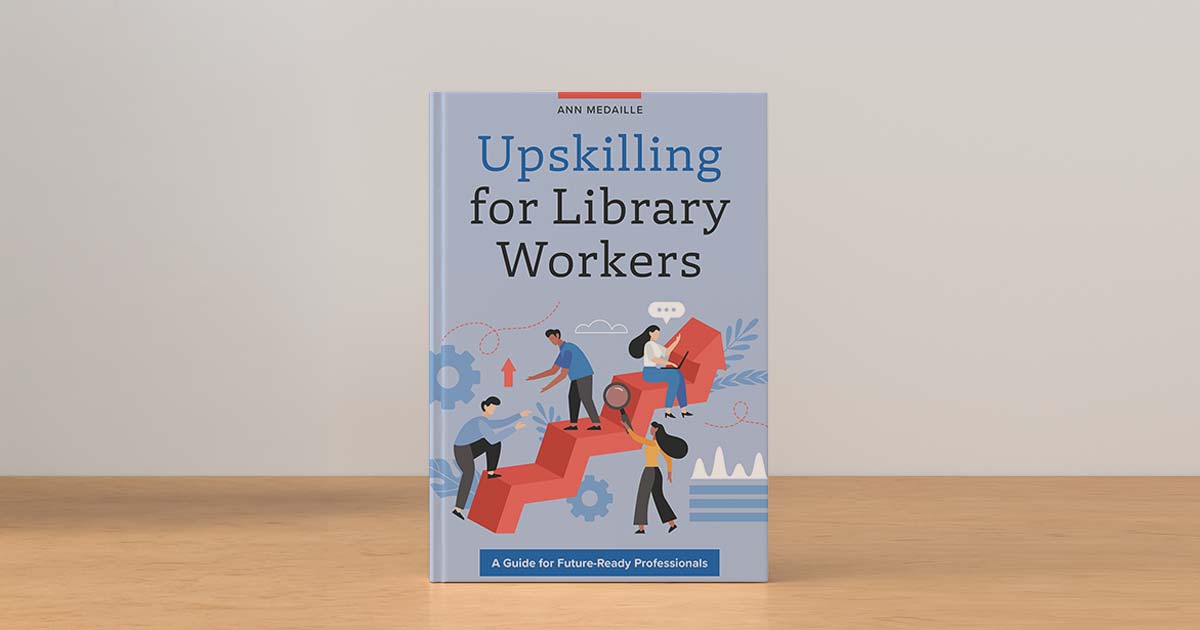
Dr. Ann Medaille is the author of Upskilling for Library Workers: A Guide for Future-Ready Professionals from the American Library Association. Her book fits so well with my current series on skills for special librarians new to the field that I’m “interrupting” myself before publishing my next post, which will cover information literacy. My interview with her is below.
Please introduce yourself to our readers.
I’m the Director of Research & Instructional Services at the University of Nevada, Reno Libraries. I’m serving my last year as Editor-in-Chief of the journal Evidence Based Library & Information Practice, and I’m a faculty member with the Medical Library Association’s Research Training Institute. I have a PhD in education and an MS in library science.
Briefly summarize Upskilling for Library Workers: A Guide for Future-Ready Professionals.
This book offers a practical guide to building staff skills for today’s needs and tomorrow’s challenges, including changes brought by AI and other technologies. Drawing on my research with academic and public library staff, I share examples, strategies, activities, reflection points, and tips to help libraries make learning new skills a more intentional and sustainable part of everyday library work.
Why did you decide to write this book?
Over the past few years, I’ve reflected on how challenging it can be for library staff to keep up with changing technologies, including those related to AI. Sometimes change can feel overwhelming. Library workers have to constantly keep their skills up, but libraries are often short on time and resources that can help them. Despite these limitations, it is possible to support successful staff upskilling. This book provides practical strategies for planning and supporting upskilling initiatives in all types of libraries.
What are two things you hope all readers take away?
- Upskilling should not be confined to occasional webinar viewings or workshop attendance. Instead, upskilling initiatives should include a holistic approach to continuous learning that is woven throughout all aspects of the library and occurs during the course of performing one’s job.
- The value of upskilling and reskilling should be reinforced in the organizational culture, which includes communicating about the importance of learning, recognizing and celebrating accomplishments that come from learning, creating supportive environments for learning, supporting learning collaborations, and empowering workers to have autonomy in their learning.
What is one thing you recommend library administrators do to encourage a culture of upskilling in their staff?
Library administrators should communicate with their staff about their own efforts as lifelong learners who are constantly willing to learn new things and reflect on their own learning successes and failures. When leaders share what they are learning and what they are struggling with, this helps to reinforce the value of learning across the organization and communicates that it is OK to struggle in the process of learning new things.
What is one thing you recommend librarians do today if they feel they need to upskill?
There isn’t just one thing but many. Librarians can seek out as many opportunities as they can: talk to their manager, seek out one or more mentors, ask to join projects in their library that can help them grow, join a network, or find online learning opportunities (many are free). Librarians can make a plan and timeline for their own learning and engage with others to help motivate them and keep them on track.
Is there a specific knowledge area where you feel upskilling is most needed?
Well, AI, of course. I think we all need to upskill in AI technologies, which includes learning new tools, integrating new tools into workflows, and learning about issues related to ethics and AI literacy. But with so much emphasis being placed on technological skills, it’s easy to forget just how important foundational and people skills are, which include things like collaboration, problem-solving, and project management. Those skills are more important than ever. However, probably the most important and long-lasting skill that a library worker can have is the ability to learn and to keep learning, as the accelerating pace of change will require workers to continually reskill.
Is there anything else you would like to share?
There’s a lot of pressure right now to upskill in AI technologies. Some people are more comfortable with this than others; for some, this kind of change feels destabilizing, scary, or even repugnant. Some library workers may worry that they will not be able to master new tools or processes—and some just don’t want to.
But whenever it is that you have to (or choose to) learn, just remember that learning new skills sometimes means getting comfortable with being uncomfortable—but only in the short term. You can’t expect to learn all things instantly, and you don’t have to be an expert in everything! You should just keep learning and know that greater comfort and adaptability will come with time.






0 Comments