


Private collectors are a unique breed of museum patrons. They spend decades—often lifetimes—meticulously hunting down, preserving, and curating their specialized collections. While these artworks and artifacts may be financial assets for some, the majority of collectors are deeply passionate about the collections they accumulate. Participating in succession planning and finding a permanent home for their treasures is a deeply emotional exercise. Above all, collectors want to ensure their collections will be both cared for and accessible to the public. Their greatest fear is institutional neglect.
Donors dread the idea of their cherished items being accepted by a museum, only to be forgotten in a dusty cardboard box in off-site storage. Fortunately, your museum’s Collections Management System (CMS) and public-facing online portal can serve as a powerful tool to eliminate this fear and inspire lifelong patronage. By displaying robust digital stewardship and embedding frictionless intake pathways, you shift your database from an internal registry to an active acquisition engine.
Building the Trust That Drives Legacy Giving
Collectors look for digital excellence when deciding where to permanently place their treasures. A highly sophisticated, universally accessible online portal acts as a transparent proof-of-concept for your museum’s collection care and management capabilities.
When a private collector browses your online catalog, they look for clues on how you treat the museum’s current holdings. Seeing that every single item—whether hanging in a prominent gallery or housed deep in off-site storage—receives comprehensive metadata, high-resolution multi-angle photography, related object linking, and public visibility sends a clear signal that your institution treats its holdings with world-class respect.
This public commitment to collection access and industry best practices is exactly what’s needed to inspire potential patrons to choose your institution for their tax-deductible object donations and major financial estate gifts.
Turning Casual Browsing into Seamless Intake
Building collector trust through a compelling online portal is only one of the ways a CMS can support the acquisition process. Creative configuration of your CMS can also offer the operational infrastructure needed to capture that donation inspiration the exact moment it strikes.
You can achieve this by transforming your static “Support Us” webpage into a dynamic, CMS-integrated object intake portal. Instead of forcing a potential donor to hunt down a curator’s email address, your online platform can feature a streamlined, intelligent acquisition form.
Placing this form directly within the online portal lowers the barrier to entry for the donor while collecting structured data that maps directly to your backend CMS fields:
- High-Quality Media Uploads: Allow collectors to easily drag and drop high-resolution photographs, signatures, and maker’s marks directly from their smartphones or computers.
- Structured Object Information Capture: Utilize clean, guided form fields to let donors detail the object’s history, condition, and how it came into their possession.
- Strategic Motivation Fields: Include a simple but powerful drop-down question to capture donor intent (e.g., “What are your long-term goals for this collection? Immediate Donation, Promised Gift via Will, Temporary Loan”).
Accelerating the Curatorial Workflow
The true magic happens when this online form communicates seamlessly with your backend database. When a collector submits their object information, the completed form will be routed to your designated inbox and offer potential acquisition information that can be used to begin object intake within your CMS.
This form feature helps to eliminate institutional friction. Museum staff can instantly evaluate the object’s metadata against existing collection gaps without messy email chains or lost paperwork. The system can then trigger a personalized, automated response to the donor, thanking them for their stewardship and outlining the next steps of the committee review process.
Museum Spotlight: International African American Museum
An example of this system in action is the International African American Museum (IAAM). The institution cleverly uses the web portal features of their CMS, Argus, to capture and facilitate potential acquisitions directly from the public.
From the main menu of the IAAM website, under “Exhibitions & Programs,” visitors can find a dedicated option to “Add to the Collection.” Selecting this option takes the visitor to an integrated webform that outlines the museum’s collecting guidelines.
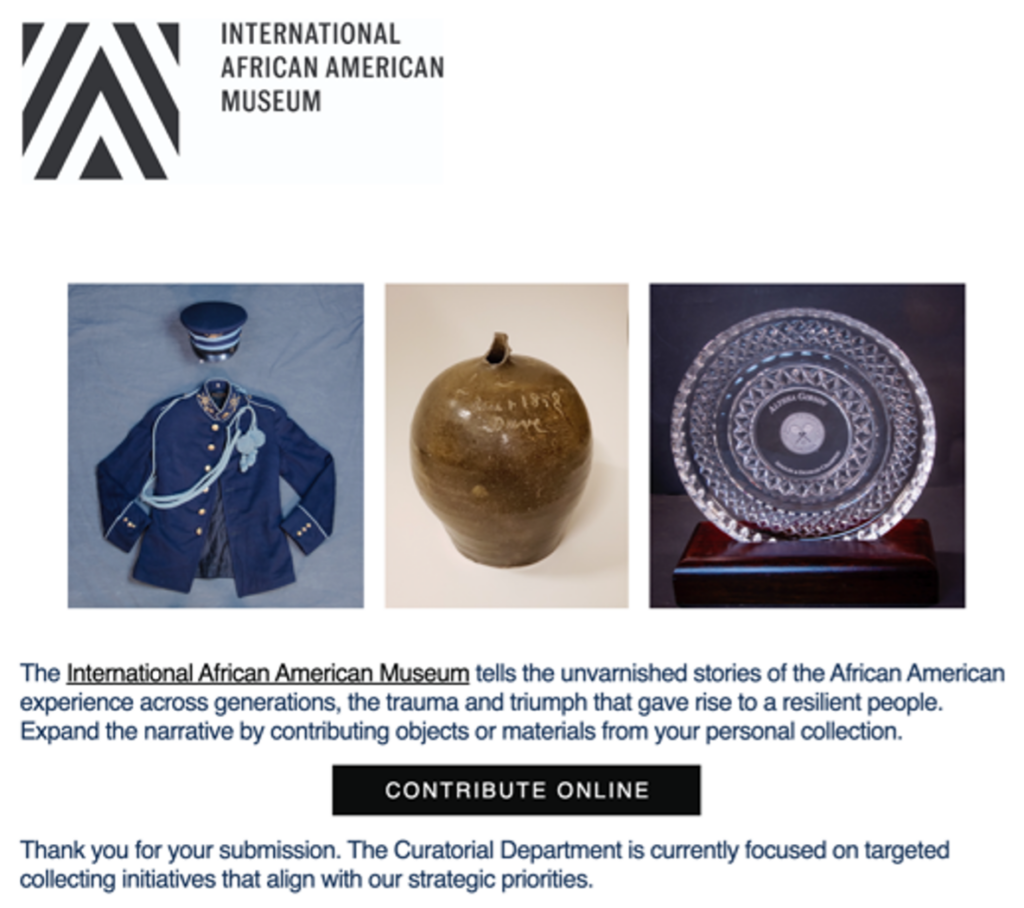
“Contribute Online,” International African American Museum, accessed July 1, 2026.
Upon reviewing the criteria, potential donors simply click “Contribute Online,” which opens a structured form to submit their object information. This creative use of a CMS-provided online portal makes it incredibly easy for potential donors to initiate a dialogue, while also offering the museum staff a clean digital workflow to support the appraisal and acquisition process.
Transforming Browsers into Benefactors
By replacing bureaucratic delays with rapid, professional engagement, you show the collector that your museum operates on the cutting edge of digital efficiency. That professional momentum cements their desire to give, transforming a casual online inquiry into a landmark acquisition for your permanent collection.
Want to learn more? Please join us when museum expert Rachael Cristine Woody presents an informative new webinar, How to Attract Patronage with the Museum CMS, on Wednesday, August 26, 2026 at 11 a.m. Pacific, 2 p.m. Eastern. Register now to reserve your seat!
Frequently Asked Questions
Can a museum’s online collections portal help attract donations and acquisitions?
Yes. A robust, publicly accessible collections portal signals strong stewardship to private collectors, and an integrated intake form lets them begin a donation the moment they are inspired—turning your CMS from an internal registry into an active acquisition engine.
What do collectors look for before donating to a museum?
Collectors look for evidence of world-class care: comprehensive metadata, high-resolution photography, related-object linking, and public visibility for every item, whether it is on display or in off-site storage. That transparency reassures them their collection will be preserved and accessible, not neglected.
How does an online object intake form streamline acquisitions?
Placing a structured intake form in your online portal captures high-quality media and guided object details that map directly to your CMS fields. Submissions route straight to staff—no email chains or lost paperwork—and can trigger an automated thank-you and clear next steps for committee review.


0 Comments